Guide · General
Air Circulator vs Fan: Which Moves Air Better at Home
By the FruitPunch research deskUpdated November 25, 202613 min read
In short
Air circulator vs fan compared on airflow, room coverage, energy use and cooling. Learn which one suits your room, budget and daily routine.
Search for advice on cooling a room and one instruction keeps coming back. Skip the ordinary fan, buy an air circulator, because it's stronger and it cools the whole room.
That advice is half right, and the half it gets wrong costs money.
An air circulator and a conventional fan do different jobs. One moves air across a room. The other makes the person in front of it feel cooler. The word circulator on the box doesn't prove that a model moves more air or uses less electricity. Measured airflow does. Airflow per watt does. So does a clear idea of what needs cooling.
Settle that and the air circulator vs fan question stops being a category argument. It becomes a choice between cooling a body and mixing a room.
Table of Contents
- Side-by-Side Answer on Airflow and Cooling
- How Each Design Pushes Air Differently
- What Independent Airflow Tests Measured
- Energy Use and Running Costs Compared
- Air Quality and the Limits of Circulation
- What Heat and Humidity Change About the Choice
Side-by-Side Answer on Airflow and Cooling
An air circulator moves air across a whole room. A conventional fan cools the person it's pointed at. That's the answer, and most buying decisions follow from it.
Both devices work on the same comfort mechanism. Moving air helps a body shed heat and lets sweat evaporate. Neither one lowers the temperature of the room itself.
The table puts the two types side by side.
| Criterion | Air circulator | Conventional fan |
|---|---|---|
| Main job | Move air across a whole room | Cool the person it points at |
| Airflow pattern | Directed high-velocity jet, often with a vortex | Focused breeze aimed at the body |
| Typical motor power | Check rated watts on the label | 10 to 100 W for most fan motors |
| Best for | Mixing warm and cool zones in larger rooms | Personal cooling at a desk or bed |
| Room temperature effect | Mixes air and does not lower room temperature | Does not lower room temperature |
| Ventilation effect | Redistributes indoor air and does not replace fresh air | Redistributes indoor air and does not replace fresh air |
Read the last two rows together, because that's where shoppers get caught. A machine sold as a whole-room circulator still only rearranges indoor air. It doesn't ventilate. A fan in the corner doesn't either. Whatever the carton claims, fresh air comes from a window, a door or a filter.
The label doesn't prove the performance
Air circulator describes a design intent. It isn't a performance grade. Two models wearing the same description can sit far apart on measured airflow and on airflow per watt. Motor efficiency and blade design decide the outcome, not the words on the box.
That's also why running costs can land close together. Both categories use small motors in a similar power band, so a circulator with a modest motor can cost less to run than a fan with a bigger one. The rated wattage printed on the spec sheet settles it, and nothing else does.
The working rule
Choose by job, then compare models on numbers. Cooling one seated person at a desk or beside a bed calls for a conventional fan, because the air arrives exactly where it's needed. Evening out a warm lounge, or a room with a hot side and a cool side, calls for an air circulator that carries air the full length of the space.
Households that want movement and filtration in one box have a third option. A purifier fan does both jobs, and the FruitPunch review of the Dyson Purifier Cool Gen1 TP10 covers a model built for that purpose.
Hold the rule in place and the rest is arithmetic: measured airflow for the money, and watts spent per cubic metre of air moved.
How Each Design Pushes Air Differently
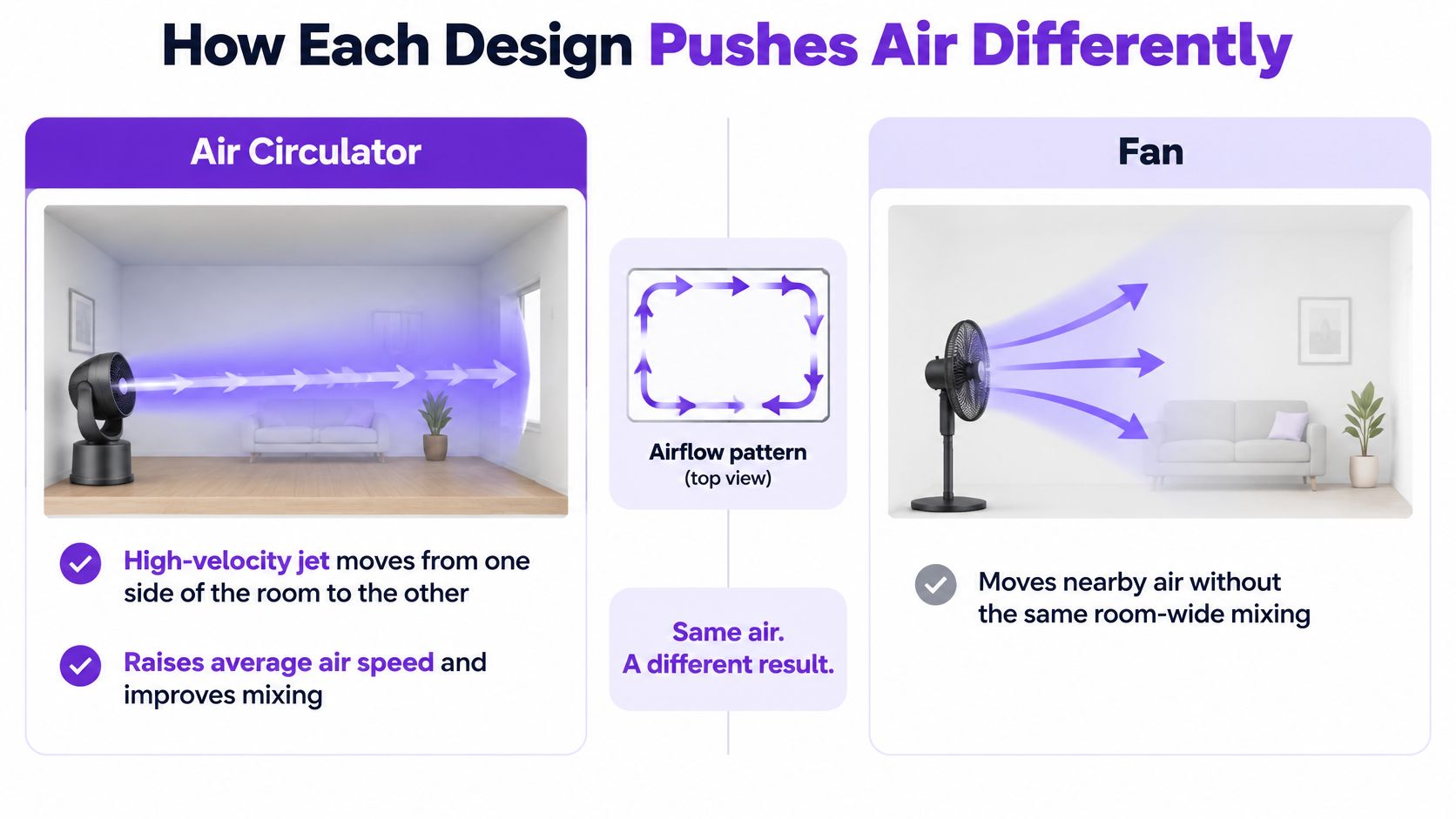
An air circulator is built to throw a fast jet from one side of an enclosed room to the other, raising average air speed and improving mixing, as Berkeley's Center for the Built Environment fan guidebook describes it. Some models use propeller-shaped or turbine-shaped blades to create a vortex that pulls surrounding air into the main stream. That entrainment is why the jet keeps travelling across a room instead of dying a metre from the grille.
A conventional fan does something narrower. It aims air at a body, where moving air increases convective heat loss and helps sweat evaporate. Pointed at a seated person, it feels strong within seconds. The useful effect is local: once the stream spreads and slows with distance, the person outside it gets little help.
One room, two problems
Take a lounge with a sun-facing window at one end and a shaded hallway at the other. On a warm afternoon the two ends can feel sharply different. A conventional fan pointed at the sofa changes how one person feels. The warm end stays warm.
Set an air circulator low, aim it along the length of that room, and the air starts turning over. Cooler air from the shaded side mixes into the warm pocket. Nobody gets a strong breeze, and the room stops having a hot corner.
The differentiator in one line: the circulator works on the room, the fan works on the person.
Where the two products came from
The categories didn't grow from the same brief. Consumer Council of Hong Kong background on the category treats air circulators as a distinct product type built around room-wide movement, while ordinary fans remain the familiar point-at-person appliance.
Two goals, two sets of hardware. On the box, look for where the air goes and how far it carries, not only how loud the top speed sounds. A model that roars at full speed still fails the room test if the jet falls apart before it reaches the far wall.
What Independent Airflow Tests Measured
Fourteen machines, one label, and a spread in output wide enough to change what a room feels like. That is what a 2019 Consumer Council of Hong Kong test of air-circulator fans found, and the council published measured airflow, price and energy results for every model in the sample.
| Measure | Tested range | What it means for buyers |
|---|---|---|
| Blade diameter, all models | 15 to 22.3 cm | Size alone does not set airflow |
| Retail price, all models | HK$480 to HK$1,698 | Compare measured airflow before paying more |
| Airflow, models with 19 to 22.3 cm blades | 10.4 to 19.9 m³/min | About a 48% gap between tested products |
| Airflow per watt, all models | 0.2 to 0.7 m³/min per watt | About a 67% gap in efficiency |
| Electricity difference, 10 hours a day for 160 days | Up to 62 units | About HK$74 at HK$1.20 per unit |
Blade size didn't settle the airflow question
The council sorted its sample by blade size, and blade size lost. Among models with 19 to 22.3 cm blades, measured airflow ran from 10.4 to 19.9 cubic metres per minute, a spread of roughly 48% between products sold as the same type of machine. A shopper who picks the widest blade is not buying the most airflow. A shopper who picks the priciest model is not either, since retail prices ran from HK$480 to HK$1,698 with no matching pattern in output.
The two numbers a buyer can read off a shelf, diameter and price, both failed to predict the number that matters.
Efficiency moved even further
Airflow per watt ranged from 0.2 to 0.7 cubic metres per minute across the sample, a gap of about 67%. That is the figure that decides the electricity bill, and it appears nowhere on the box. Two circulators can move similar amounts of air while one spends well over twice the energy of the other doing it.
The council priced that gap directly. Running these fans for 10 hours a day over 160 days could produce as much as a 62-unit difference in electricity consumption, which it valued at about HK$74 at a stated rate of HK$1.20 per unit. Efficiency differences that look trivial on a spec sheet turn into a real bill across a single stretch of hot weather.
How to shop after reading a test like this
- Find the measured airflow first. Look for cubic metres per minute or cubic feet per minute on the spec sheet, not a marketing word like turbo or hurricane.
- Divide airflow by rated watts. That single number separates efficient models from hungry ones, and it travels well across brands.
- Treat price as a separate question. A higher price buys features, finish or app control. It does not reliably buy airflow.
- Recalculate the running cost locally. Take the unit difference, then apply your own electricity rate rather than the Hong Kong one.
One caution on scope. This was a single test, in a single city, on a single tariff, covering fourteen models. It crowns no brand. What it shows is that the circulator label carries no guarantee: measured airflow is what separates a machine that turns a whole room over from one that only pushes a breeze at the person in front of it. Where the priority is direct personal cooling rather than mixing the room, a conventional fan remains the better buy.
Energy Use and Running Costs Compared
A fan is a small load. Massachusetts energy guidance on ceiling fans puts fan motors at about 10 to 100 watts, depending on type, size and speed, and an energy guide in the same document estimates about 300 kilowatt-hours a year for a typical ceiling fan with a light kit.
The arithmetic is short. Kilowatt-hours equal watts multiplied by hours, divided by 1,000. A 50-watt fan running for 10 hours uses 0.5 kilowatt-hours before local rates are applied. Run that across eight hours a day and a year, and the picture scales like this.
| Fan motor power | Daily use at 8 hours | Yearly use | Cost per year |
|---|---|---|---|
| 10 W | 0.08 kWh | 29.2 kWh | Multiply by your local rate |
| 50 W | 0.4 kWh | 146 kWh | Multiply by your local rate |
| 100 W | 0.8 kWh | 292 kWh | Multiply by your local rate |
| Typical ceiling fan with light kit | About 0.8 kWh averaged across the year | About 300 kWh | Multiply by your local rate |
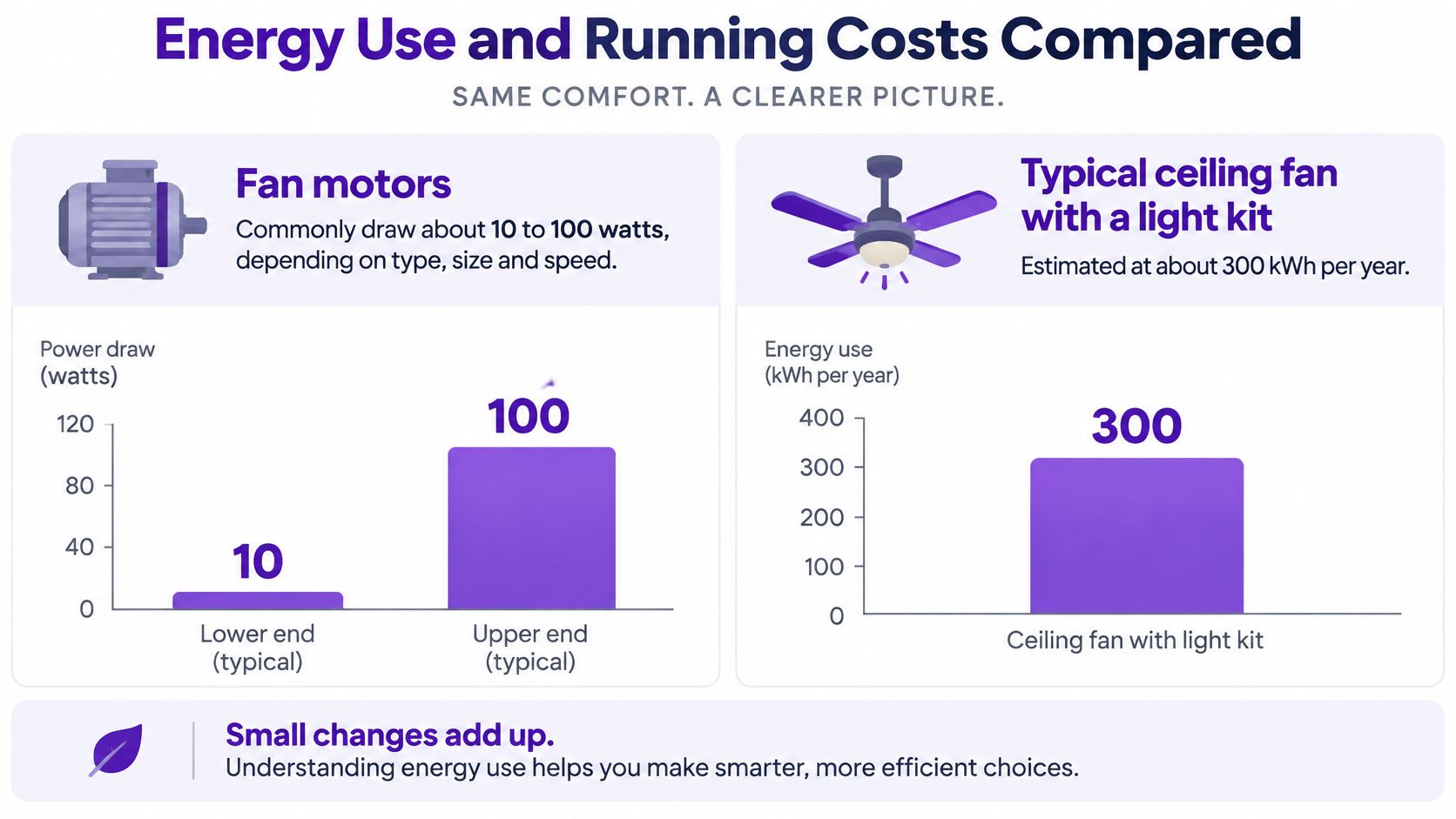
Nothing in that table separates an air circulator from a conventional fan, because the physics doesn't. Rated watts and hours decide the bill. The label on the carton doesn't, so a model advertised as an energy-saving circulator deserves the same scrutiny as any other fan.
The bigger lever sits on the thermostat
Berkeley's Center for the Built Environment reports that raising the HVAC temperature setpoint by about 3 °C while using fans can save roughly 32% of HVAC energy, and that fan operation itself can consume less than 1% of total household energy in the cited scenario. A household arguing over two fan types is arguing over a rounding error next to the setpoint.
Those savings depend on occupancy and control strategy, though. They aren't automatic.
What to do with the numbers, in order:
- Check the rated power. The spec sheet states watts. If a listing doesn't, that's a reason to skip the model.
- Multiply by daily hours. Be honest about them. A fan left on from morning to night costs several times what a fan used at bedtime costs.
- Apply the local rate. Take the kilowatt-hours from the table and multiply by the price per kWh on the bill.
- Match speed to the job. High speed draws more and often isn't the setting people leave a circulator on all evening.
- Run it only in occupied rooms. A fan that spins with nobody present spends watts on nothing.
Air Quality and the Limits of Circulation
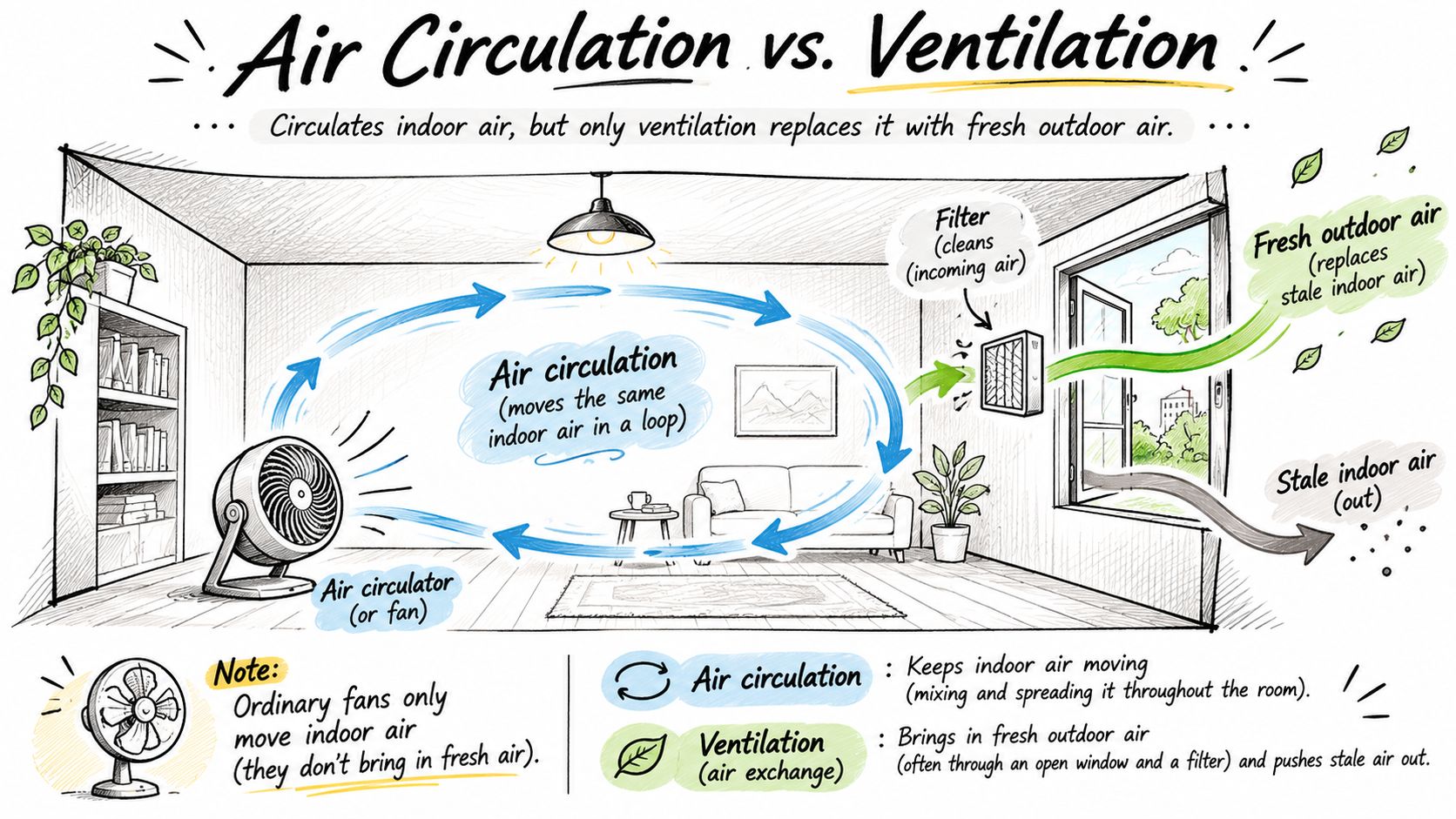
Moving air can feel cleaner. It usually isn't. A fan moves the air already in the room, while ventilation replaces stale indoor air with outdoor air or passes it through a filter. Those are different jobs, and research on fan-generated indoor airflows shows why the difference matters in a kitchen or a bedroom with someone unwell in it.
Circulation can carry contaminants with it
More airflow does not automatically mean cleaner air. Fan-generated flows can move airborne plumes and contaminants downstream. Weak placement and poor outdoor-air exchange can spread pollutants or infectious aerosols instead of clearing them. The device is still doing useful work, but it is redistributing what is already present.
The counterpoint depends on the path available. A ceiling fan used with an open window and door can help move fresh air through a room, and higher fan speeds can increase that movement. Same device, different result. Fresh air needs somewhere to enter and somewhere to leave, or the fan mostly stirs the existing room air.
A fan doesn't clean air. It decides where the air goes, and that's a placement decision the buyer makes.
Placement decisions that change the result
- Kitchen: start the extractor hood at the hob, then aim any circulator along the room rather than across the doorway into the rest of the house.
- Bathroom: an exhaust fan does this work. A circulator in the doorway pushes damp air outward.
- Smoke or heavy haze: seal up and filter. Stirring the air mixes particles through the whole room.
- Beside an air cleaner: angle the jet across the room so cleaned air circulates, rather than blowing straight back into the unit's intake.
- Window at one end, door at the other: line the airflow up with that path to help push stale air out.
Those choices separate two questions that often get merged. The first is whether a person feels cooler in the moving air. The second is whether the room receives cleaner air. A circulator can help with room-air movement, but the label alone does not create ventilation, remove particles, or lower humidity. An exhaust path or a filter has to do that work.
For rooms where filtration is the actual need, the FruitPunch ranking of air purifiers compares models on the numbers that matter, including clean air delivery rate.
The video below walks through how air behaves when it moves between rooms and why a fan alone doesn't refresh a space.
Airflow is not a substitute for source control, filtration or exhaust ventilation. It's a distribution tool, and it works well only when there's something worth distributing.
What Heat and Humidity Change About the Choice
The comfort fact: a fan doesn't lower the temperature of a room. It makes the person in that room feel cooler.
A 2025 heat-health review gives a usable benchmark. Air moving at 1 metre per second around a person in a 27 °C room at 50% relative humidity can produce a thermal sensation comparable to air about 4 °C cooler than still air, according to the University of Arkansas Division of Agriculture guidance on air movement and heat. That's a serious comfort return from a device drawing under 100 watts.
Why humidity sets the ceiling
Air movement increases the evaporation of moisture from skin, and higher humidity makes that benefit weaker. When air temperature sits below skin temperature, moving air also increases convective heat loss. As humidity climbs, evaporation does less of the work and the felt difference shrinks.
This is the part most comparisons skip. A circulator and a fan use the same comfort mechanism when they're pointed at people. The circulator's extra purpose is room-air movement, and room-air movement doesn't dry a room.
Where each device fits
| Situation | Better pick | Reason |
|---|---|---|
| One person at a desk or bed | Conventional fan | Airflow aimed at the body drives the cooling feel |
| Large open-plan room or lounge | Air circulator | A directed jet carries air across the room |
| Hot and cool zones in one room | Air circulator | Mixing evens out air between zones |
| Humid climate or heatwave | Neither alone | Airflow cannot replace dehumidification or heat management |
Heatwaves and humid climates
In a muggy climate, airflow improves perceived comfort but can't replace dehumidification. In a heatwave, airflow can't replace safe heat-management practices either. Neither device is a cooling appliance in the way an air conditioner is, and treating one as a substitute during extreme heat is a mistake.
Households that want the temperature and humidity side handled automatically can compare controls in the FruitPunch ranking of smart thermostats, which covers the models that schedule and hold a setpoint.
The mixed-household answer
Plenty of homes end up owning both devices, and that's not indecision. A small fan handles the desk or the bedside, where a focused breeze does the job at low wattage. A circulator handles the living room, where the problem is air that won't move between a warm end and a cool end.
The sensible sequence is to buy the second device only after the first has proved it can't cover the other job. Two fans in one room usually means one of them is in the wrong place.
One day in place before deciding
Run the chosen unit for a day in the spot it will live, then check four things.
- Reach: sit where the reader would sit. If the air doesn't arrive at face height on the setting that will realistically run, the device fails its main job.
- Mixing: after an hour, walk to the far side of the room. A circulator that hasn't shifted the warm pocket needs a different angle, not a higher speed.
- Noise: judge it at the setting that will be used all evening, not at maximum for thirty seconds in a shop.
- Setting: many people settle on low or medium. Test there, because the top speed sells the product and the middle setting runs it.
If a unit passes reach and fails mixing, it's a personal fan wearing a circulator label. That's the whole test, and it takes a day.
FruitPunch is an independent publication that compares consumer products, software and everyday services using a published scoring framework, with prices checked against the seller and dated. Its home-product rankings put models side by side on airflow, running cost and value, which is the fastest way to turn the measured thinking above into a shortlist. Visit FruitPunch to browse the rankings and the sourced statistics behind them.
Cite this page
FruitPunch. (2026, November 25). Air Circulator vs Fan: Which Moves Air Better at Home. https://fruitpunch.ai/air-circulator-vs-fan
Spotted an error in this guide? Email editorial@fruitpunch.ai