Guide · General
Are Coding Bootcamps Worth It in 2026? Costs and Odds
By the FruitPunch research deskUpdated November 29, 202616 min read
In short
Are coding bootcamps worth it? See real costs, sourced graduate outcomes, study evidence, job-market limits and when a bootcamp pays off in 2026.
A coding bootcamp is worth it only when it leads to a technical job a graduate can reach within a reasonable time and the expected salary gain exceeds the total cost, including lost wages. Even the widely cited 66% full-time employment figure from a 2015 alumni survey is self-reported, not proof that paying tuition automatically produces a raise.
Most buyers compare a bootcamp's sticker price against an entry-level tech salary and assume the math settles itself. That shortcut misses the financial test. Treating a bootcamp like a loan against future pay changes the picture completely, because lost wages during full-time study and months spent hunting for a first role often outweigh tuition itself.
When the FruitPunch research desk evaluates whether coding bootcamps are worth it, the question isn't whether software careers pay well. The question is how many months it takes to break even on the full cash outlay, and whether an applicant's savings, schedule, and local hiring market can survive the gap.
Table of Contents
- Are Coding Bootcamps Worth It? The Short Answer
- What a Bootcamp Is and What It Really Costs
- What the Outcome Evidence Really Shows
- Bootcamps Compared With Lower-Cost Routes
- Entry-Level Job Demand for Bootcamp Graduates
- Break-Even Math With Real Numbers
- Run This Enrollment Test Before You Pay
Are Coding Bootcamps Worth It? The Short Answer
A coding bootcamp is a strong buy for a narrow group of career changers and a poor deal for everyone else. The split comes down to individual constraints: savings, available study hours, local employer demand, and whether a target job requires a formal degree.
To sort those cases quickly, match an applicant's starting point against the six common scenarios below.
| Situation | Verdict | Main reason |
|---|---|---|
| Career changer with time for full-time study | Often worth considering | Structured training and job-search support can speed up the first technical role |
| Already working in tech and seeking a promotion | Usually not needed | Targeted courses or on-the-job learning often cost less |
| Needs a licensed or degree-based credential | Not enough alone | Regulated roles require the formal path |
| Cannot repay a loan from a lower starting wage | Risky | Repayment can stretch past a year at junior pay levels |
| Wants to test interest in coding first | Try free or low-cost courses first | Low commitment reveals whether the work suits you |
| No job-search time or weak local tech hiring | Weak case | Outcomes depend heavily on local demand and effort |
The Financial Rule Behind Every Verdict
Every row in that matrix rests on one economic test. A bootcamp pays off only when it leads to a technical role within a manageable search window and the expected salary increase clears the total cost of attendance, including tuition, living expenses, and foregone pay.
A bootcamp certificate isn't an asset on its own. Its value exists only when an employer pays more for the graduate's new skills than the total cash and wages given up to earn them.
That test matters because the boldest placement percentages in bootcamp brochures come from voluntary graduate surveys rather than independent comparisons. Self-reported figures reflect the people who finished the course and chose to answer a questionnaire, leaving out dropouts and silent non-responders. Testing those numbers against real budgets, controlled research, lower-cost alternatives, entry-level hiring demand, and a strict pre-enrollment checklist separates a calculated career move from an expensive gamble.
What a Bootcamp Is and What It Really Costs
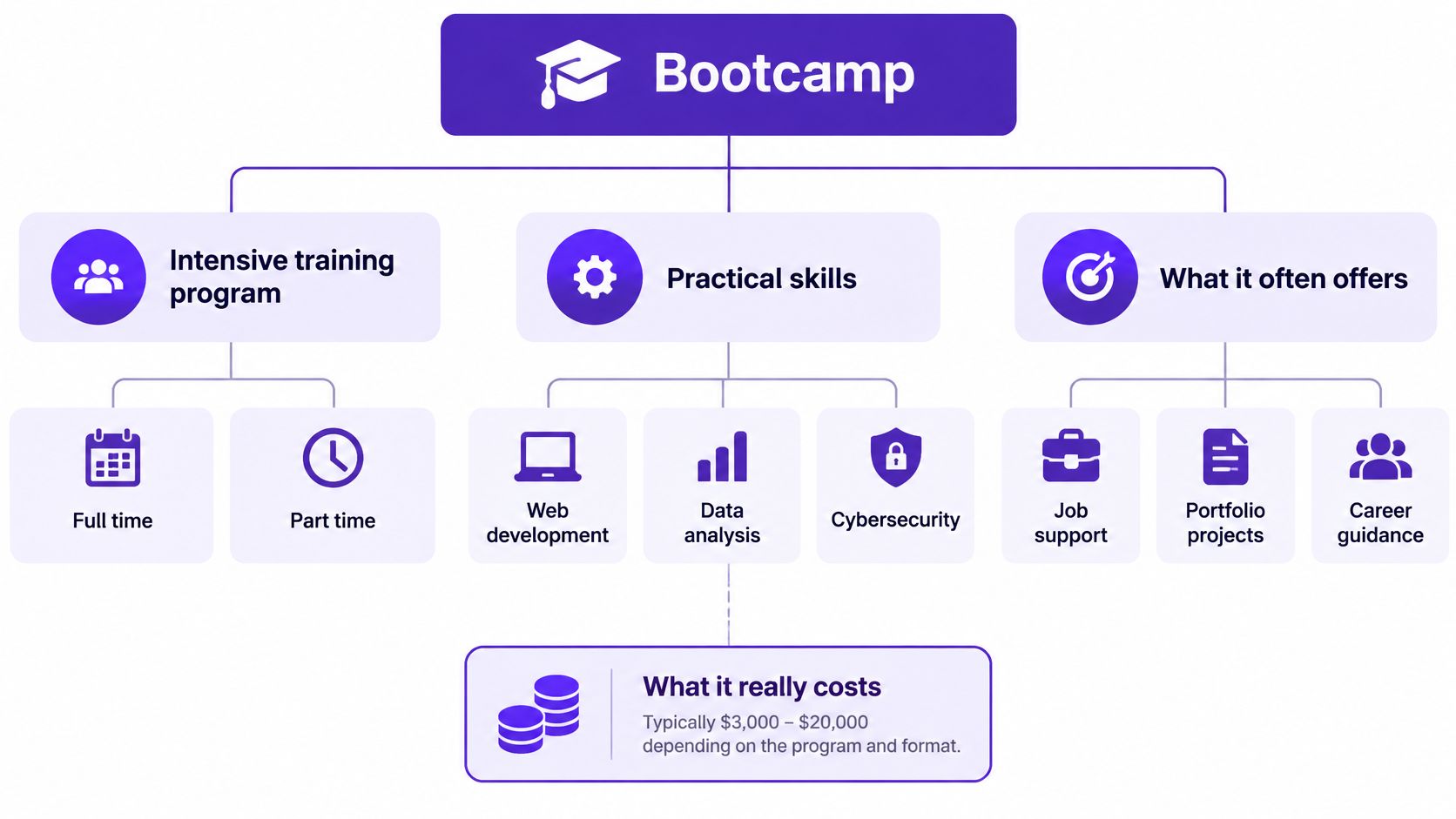
A coding bootcamp is an intensive, short-term training program designed to teach practical technical skills fast. Providers run cohorts on either a full-time schedule, which leaves little room for paid work, or a part-time track built around evenings and weekends. Curricula usually focus on applied fields such as web development, data analysis, or cybersecurity, paired with portfolio projects and career coaching.
The diagram below maps out how a typical bootcamp bundles its schedule, skill tracks, career services, and full cost structure.
Six Cost Components Beyond Tuition
Advertised tuition is rarely the largest bill an applicant faces. Quitting a job to attend class, financing the fee over several years, and funding a multi-month job search all belong in the same ledger.
| Cost item | What it includes | Where to verify |
|---|---|---|
| Tuition | Program fee, sometimes quoted per course or per cohort | Provider's current price page, dated when checked |
| Financing charges | Loan interest, deferred payments or income share terms | Provider's financing terms and the loan contract |
| Living costs | Rent, food, transport and any reduced working hours | Your own monthly budget |
| Foregone income | Wages not earned during full-time study | Your current monthly pay multiplied by program months |
| Job-search costs | Portfolio hosting, interview preparation, relocation or travel | Personal estimate with written quotes where relevant |
| Equipment and software | Laptop upgrades, paid tools and subscriptions | Seller pages and the program's required-equipment list |
Because providers revise cohort fees and financing terms regularly, older published averages serve only as historical reference points. Anyone building a budget should pull live figures straight from each school's current pricing page and write down the exact date checked. That is the same standard FruitPunch applies across its own product and course guides, where vendor prices carry a verification date and unconfirmed sellers are flagged rather than estimated.
Why Hidden Costs Warp the Budget
Consider a straightforward full-time scenario. Say an applicant enrolls in a 12-week full-time program and steps away from a job paying regular monthly wages for those three months. Even if the school's listed tuition looks manageable next to a four-year degree, three months of foregone income plus rent, groceries, and a laptop upgrade can easily double the cash outflow before the graduate sends a single resume.
Financing agreements can push that total higher still. Deferred tuition plans and income-share contracts reduce upfront cash strain, yet interest charges, origination fees, and repayment caps often leave borrowers paying substantially more than the sticker price. Every honest comparison of bootcamp value has to start with total out-of-pocket cost plus lost wages, never tuition alone.
What the Outcome Evidence Really Shows
Graduate surveys point to large pay jumps, while controlled studies point to smaller, short-term employment gains. Both sets of numbers are real, yet they answer very different questions about what a bootcamp delivers.
The table below compiles the main public benchmarks, their reporting scope, and the primary limitation affecting how far each figure can be trusted.
| Source | Year | Reported result | Main limit |
|---|---|---|---|
| Course Report alumni study | 2015 | 66% full-time in relevant work; 38% average salary increase (about $18,000); average tuition about $11,800 | Self-reported; only graduates who respond |
| Course Report placement report | 2019 | 83% in jobs needing bootcamp skills; median salary increase 51% ($22,000); average tuition $13,728 | Self-reported, same response bias |
| International Telecommunication Union summary | Historical summary (no single cohort year) | More than 67 providers; about 75% in full-time work; salaries rose from $46,638 to $64,255 | Summarises earlier surveys rather than new data |
| Council on Integrity in Results Reporting summary | 2024 to early 2025 cohorts | Graduation 70% to 94%; in-field employment within 180 days 64% to 78%; median first salary $63,000 to $71,000 | In-field definitions vary by provider and region |
| World Bank randomized trial, Argentina and Colombia | Short-run post-training trial | Participation raised the probability of a technology job by 9.2 percentage points, about 38% above control | Short-run employment effect, not guaranteed long-term earnings |
| Code Louisville review of public and quasi-experimental programs | Multi-year follow-up (up to 3 years) | About 5 points employment gain; 5% to 10% higher quarterly earnings; about 15% for women after three years | Limited to specific programs and places |
How Headline Survey Numbers Break Down
Historical alumni surveys explain why bootcamps attracted so much attention. According to the Course Report 2019 placement report, its earlier 2015 alumni study found 66% of surveyed graduates working full time in roles requiring bootcamp skills, with an average salary lift of 38% (roughly $18,000) against average tuition of about $11,800. Walk through that raw ratio and the gross first-year salary gain equals about 1.5 times tuition before taxes, loan interest, living costs, or unpaid job-search weeks enter the picture.
By 2019, the same report recorded 83% of surveyed graduates in jobs requiring bootcamp-acquired skills, a 51% median salary jump ($22,000), an average starting salary of $66,964, and average tuition of $13,728. Broader industry roundups painted a similar early picture. A report from the International Telecommunication Union counted more than 67 providers across the United States and Canada graduating over 16,000 students, with roughly 75% finding full-time work, alongside an earlier 44-provider survey of over 600 graduates where average pay climbed from $46,638 to $64,255.
Yet the same ITU brief flags a regional warning from Medellín, Colombia, where junior developers were estimated to earn $400 to $500 per month. At those local wages, clearing a training loan plus placement fees could stretch past a full year even if half of monthly pay went to debt. More recent audited snapshots also show wide dispersion across schools. A Bay Valley Tech summary of 2024 to early-2025 CIRR cohorts reported graduation rates spanning 70% to 94%, in-field employment within 180 days ranging from 64% to 78%, and median starting salaries between $63,000 and $71,000 depending on region.
What Controlled Studies Show Instead
Voluntary alumni surveys can't separate the effect of the bootcamp from the drive, prior background, or location of the people who finished and responded. Experimental research strips out that selection bias by tracking participants against a comparable control group.
A World Bank randomized controlled trial in Argentina and Colombia found that attending a coding bootcamp measurably improved coding skills and increased the probability of landing a tech job by 9.2 percentage points, a 38% relative increase over the control group. That causal gain proves applied training can move the needle in the short run, though it doesn't guarantee long-term retention or permanent wage growth.
Independent quasi-experimental evaluations look similarly measured. A TalentUp review of public and quasi-experimental programs summarized outcomes for Code Louisville showing roughly 5 percentage points of employment gain and 5% to 10% higher quarterly earnings after several years, reaching about 15% for women after three years. The same review noted that LaunchCode apprenticeship completers earned a larger income lift than people who completed classroom coursework alone.
Verification standard: Never judge a bootcamp on headline salary percentages without checking three numbers first: an audited definition of "in-field" placement, the cohort's actual completion rate, and job outcomes for completers reported separately from all enrolled students.
Bootcamps Compared With Lower-Cost Routes
A five-figure cohort isn't the only bridge into software work, and for disciplined learners it's rarely the cheapest one. Comparing the main alternatives side by side clarifies what bootcamp tuition buys: fixed deadlines, peer accountability, and employer introductions rather than secret knowledge.
- Paid apprenticeships or work placements: Earn a wage while building real production code alongside senior engineers, though seats are selective and regional availability is uneven.
- Community college or certificate programs: Deliver accredited coursework and structured faculty feedback at lower public tuition, yet move on slower academic calendars with lighter interview coaching.
- Self-paced courses built around portfolio projects: Cost little or nothing and fit around a full-time paycheck, but stall quickly without personal discipline, code review, and external deadlines.
- Computer science degree: Supplies the formal credential and deep theory required for specialized engineering roles, at the price of multi-year tuition and extended foregone wages.
- Employer-funded training in a current job: Eliminates out-of-pocket fees and preserves a steady paycheck, though skill choices stay tied to the current employer's tech stack.
- Public workforce programs: Offer grant-funded technical training and local hiring ties to eligible residents, while cohort schedules, seat caps, and curricula stay tightly restricted.
Why Work Experience Often Beats Classroom Time
Classroom drills rarely replicate the messy realities of production software, where engineers work through legacy repositories, write automated tests, review pull requests, and debug live outages. That gap helps explain why the LaunchCode findings point to employer-based apprenticeships outperforming standalone classes on long-term income. Working inside an engineering team solves both the skill gap and the credibility gap at once, because hiring managers trust shipped workplace code far more than a graduation certificate.
Learners who want to test their momentum before spending thousands can start with structured low-cost tools featured in FruitPunch's guide to the best learn-to-code platforms. Spending a few disciplined weeks building small projects in HTML, CSS, JavaScript, or Python reveals quickly whether coding feels engaging or exhausting.
Matching the Route to the Goal
- Choose a bootcamp when external deadlines, daily instructor feedback, and active job-search coaching are essential to finishing, and the full budget can absorb lost pay.
- Choose a self-paced route when personal study habits are already reliable, a current paycheck must stay intact, and building a public GitHub portfolio independently feels realistic.
- Choose a formal degree when target employers list a bachelor's credential as a hard screening requirement or the career goal leans toward research, systems architecture, or regulated industries.
Entry-Level Job Demand for Bootcamp Graduates
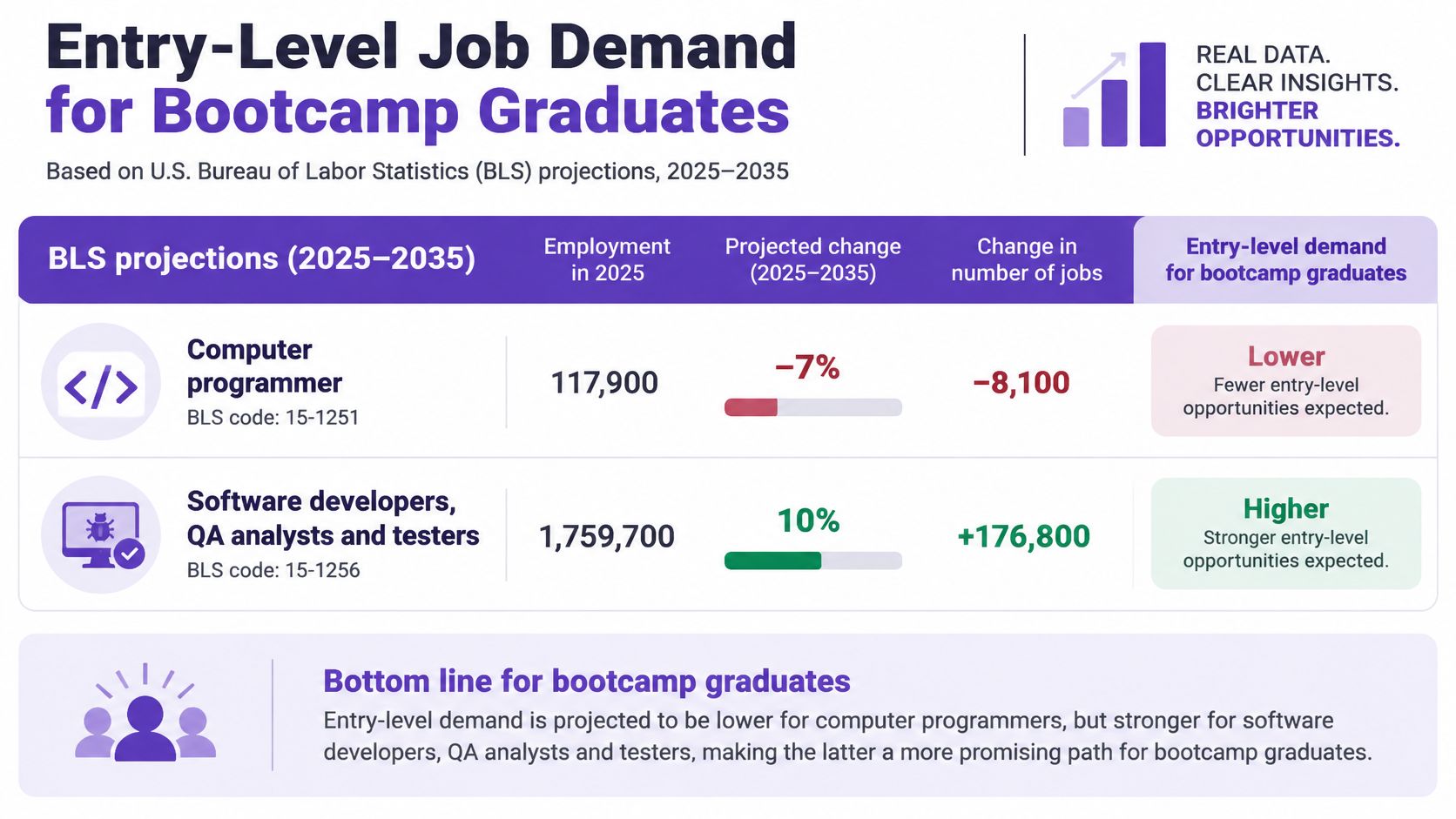
Hiring demand across technology is uneven, and broad optimism about software careers can hide sharp declines in specific job titles. According to the Bureau of Labor Statistics outlook for computer programmers, U.S. employment in the computer programmer category is projected to decline by 7% from 2025 to 2035, a drop of roughly 8,100 jobs.
By contrast, the Bureau of Labor Statistics outlook for software developers, quality assurance analysts, and testers projects 10% employment growth over that same 2025 to 2035 decade, representing 185,400 additional jobs. The visual breakdown below highlights how sharply those two occupational tracks diverge.
Why Aggregate Growth Masks Beginner Bottlenecks
A 10% ten-year expansion sounds reassuring until an entry-level applicant competes for a single junior seat. National projections lump senior architects, mid-level engineers, and beginners into one total, so they don't reveal how many postings accept a career changer with zero prior title. Meanwhile, candidate supply remains heavy. A Career Karma 2024 bootcamp market report counted 34,588 students graduating from a major coding bootcamp during the first half of 2024 alone.
That supply pressure matters for your wallet, not just your odds. Entry-level screening has tightened, and graduates commonly report that a first role takes months to secure, a stretch spent competing with experienced developers while teams adjust their priorities. Every month of searching is a month the loan against your future pay keeps running with no income gain to service it. Readers tracking how automation is reshaping junior engineering workloads can explore those hiring shifts in FruitPunch's compilation of AI job impact statistics.
| Measure | Reported figure | What it means for a beginner |
|---|---|---|
| Computer programmers, 2025 to 2035 | Employment down 7%, about 8,100 jobs | The generic coding role is shrinking |
| Software developers, QA analysts and testers, 2025 to 2035 | 10% growth, about 185,400 added jobs | Growth exists, but junior access is not automatic |
| Time to first role after graduation | Often several months, with wide variation between graduates | Plan the budget around a search period, not a graduation date |
| Apprenticeship completers vs course completers | Apprenticeship completers earned a larger long-run income lift than classroom-only completers | Structured work experience matters as much as the course |
The short video below walks through how current entry-level developer expectations affect bootcamp graduates navigating technical interviews and hiring filters.
Four Ways to Align Training With Real Hiring
- Target expanding job titles: Aim curricula and applications at software engineering, full-stack application development, or QA automation rather than generic entry-level "coding" labels, because the programmer category is the one BLS expects to shrink.
- Audit portfolio relevance: Inspect graduate capstones before enrolling to confirm students ship deployed applications with tests, documentation, and version control rather than copy-pasted tutorial clones.
- Verify the employer pipeline: Ask whether career services include direct hiring-partner interviews, paid apprenticeships, or employer showcase days instead of passive job-board links. The apprenticeship evidence suggests embedded work experience carries the income lift, so a program that routes graduates into real teams is worth more than one that only forwards listings.
- Fund the search runway: Keep liquid cash on hand to cover rent and loan minimums for up to six months past graduation day, not just the weeks spent in class. Since the search period is unpredictable, this cash buffer is what prevents a slow first hire from turning a sound investment into a forced fire sale of your time.
Break-Even Math With Real Numbers
Headline placement rates hide financial risk because they ignore timing. A cleaner way to judge whether a bootcamp makes sense is a break-even calculation that treats total cost like an investment that has to pay itself back out of higher monthly wages.
The core formula requires two simple steps:
Break-even formula: Break-even months after graduation = (Total cost / Monthly salary gain once hired) + Months spent searching for the first job.
Total cost adds six items together: tuition, financing charges, extra living expenses during study, foregone pay, job-search expenses, and equipment. Every applicant should plug in personal pay stubs and written provider quotes, because small shifts in current salary or search length swing the timeline dramatically.
A Worked Illustrative Example
To see why tuition-only math misleads buyers, walk through an illustrative calculation using representative placeholder inputs rather than a live school quote.
- Illustrative tuition: Start with $11,800 in program tuition, paid upfront with no loan interest.
- Foregone wages: Suppose the learner leaves a job paying $3,000 per month for a 12-week (three-month) full-time cohort, giving up $9,000 in earnings.
- Living expenses: Add $2,400 in out-of-pocket living costs drawn from savings during the study block.
- Equipment: Add $300 for software subscriptions, hosting, or hardware accessories.
- Total cost: Sum those four items to reach $23,500 in true upfront and opportunity costs.
- Expected monthly pay gain: Assume a gross annual raise of $18,000, which equals $1,500 per month before taxes.
- Break-even timeline: Divide $23,500 by $1,500 to get roughly 16 months of work after starting the new job, then add an assumed 3-month job search for a total of about 19 months after graduation.
Look at the distortion created by ignoring hidden costs. Looking at the $11,800 tuition bill alone against $1,500 in monthly gain produces an apparent break-even of roughly 8 months. Including lost wages, living expenses, and a modest three-month search more than doubles the payback window to 19 months.
Adjust for Take-Home Pay and Repayment Risk
Even that 19-month estimate is optimistic because it uses gross pre-tax income. Federal, state, and payroll taxes reduce the actual cash landing in a checking account each month, pushing true net break-even several months farther out. Adding private loan interest or an income-share agreement stretches the payback line even more.
Run the same worksheet a second time under a pessimistic stress test: double the assumed job-search length and cut the expected raise by a third. If the resulting break-even timeline stretches past the repayment period a household budget can handle comfortably, skipping the bootcamp or shifting to a part-time, lower-cost path protects personal finances from an avoidable debt trap.
Run This Enrollment Test Before You Pay
Before signing a tuition agreement or putting down a deposit, every prospective student should put the school through a written audit. Verbal assurances from an admissions representative don't replace documented cohort data or signed contract terms.
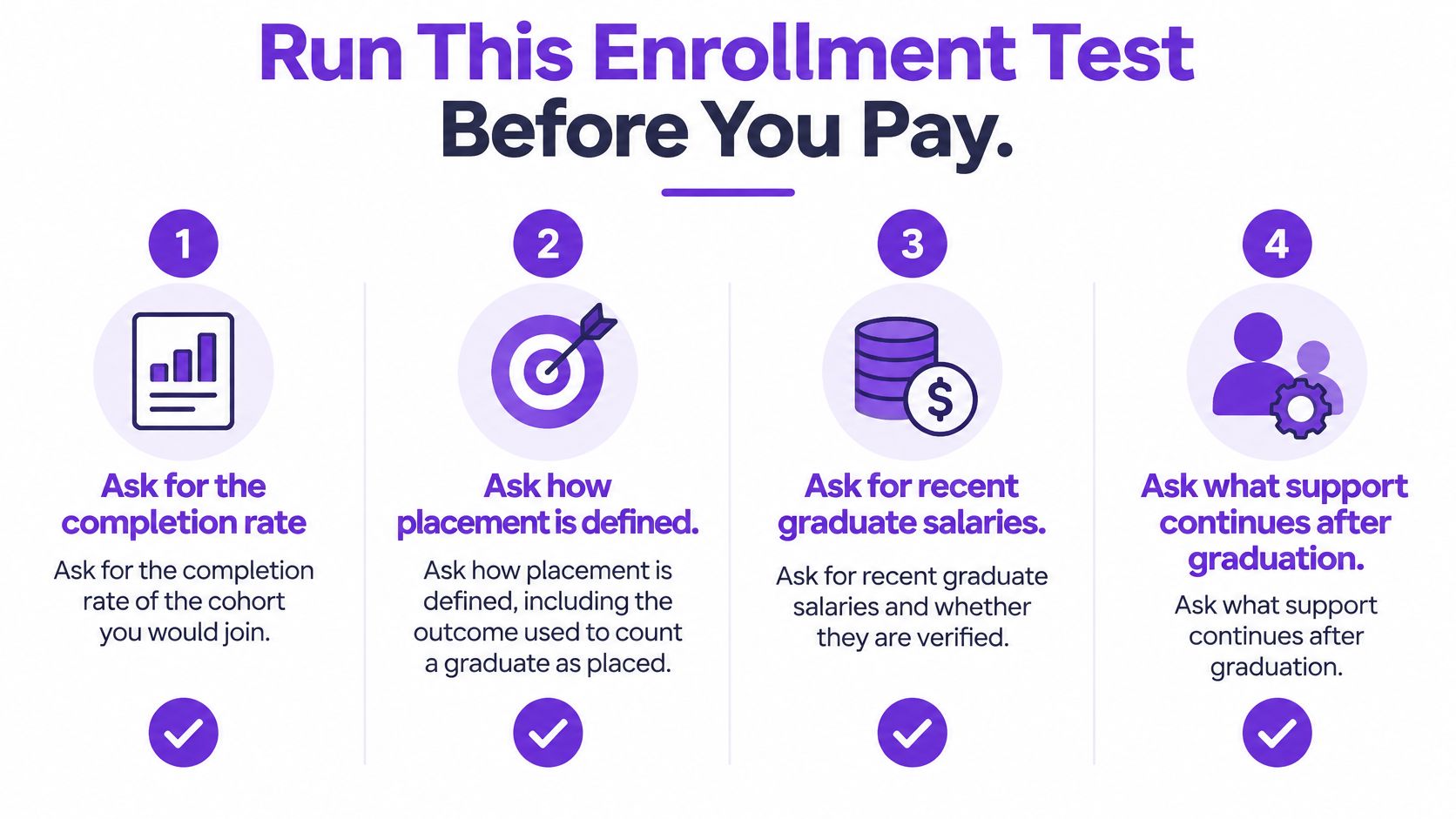
The checklist infographic below highlights four foundational questions to bring into every admissions call before committing funds.
Seven Checks to Complete Before Signing
- Request the exact cohort completion rate. Ask what percentage of students who started the specific track and format you plan to join finished on schedule, not just the school's historical best cohort.
- Verify the placement definition and window. Confirm in writing what counts as "placed" (full-time salaried roles versus short-term contracts or school teaching-assistant gigs) and whether the reporting window is 180 days or longer.
- Demand independently audited outcomes for completers and enrollees separately. Separating graduates from everyone who originally paid tuition reveals whether high placement rates rely on filtering out struggling students mid-program.
- Dissect every financing clause. Read the full loan contract or income-share agreement for annual percentage rates, deferral rules, minimum income triggers, payment caps, and default penalties before choosing a payment plan.
- Get refund and withdrawal rules in writing. Confirm how much tuition comes back if you withdraw during week one, face a medical emergency, or need to defer to a later cohort.
- Run the break-even sheet with live quotes. Plug your current monthly take-home pay, the school's written price quote, and a conservative search reserve into the break-even formula on paper so the downside is visible in dollars.
- Cross-check the curriculum against local job listings. Open current entry-level postings in your city and verify that the bootcamp teaches the actual frameworks, testing tools, and development workflows employers list, alongside everyday editor environments covered in FruitPunch's Visual Studio Code review.
Tuition schedules, financing partners, and refund terms change from one cohort to the next, so double-check every figure directly on the provider's own website on the day you enroll. This guide is independent research rather than personalized financial advice, and a program that pays off handsomely for one career changer can still be a costly mistake for another.
FruitPunch is an independent research publication that evaluates coding bootcamps, learning platforms, software tools, and everyday services using a transparent scoring model weighted across quality, ease of use, and value. Readers weighing a career switch can compare scored bootcamp rankings, dated pricing checks, and sourced career statistics side by side before spending a dollar. Explore the latest rankings and evidence-based buying guides at FruitPunch.
Cite this page
FruitPunch. (2026, November 29). Are Coding Bootcamps Worth It in 2026? Costs and Odds. https://fruitpunch.ai/are-coding-bootcamps-worth-it
Spotted an error in this guide? Email editorial@fruitpunch.ai