Guide · General
Bagged vs Bagless Vacuum Cleaners: Which Fits Your Home
By the FruitPunch research deskUpdated November 26, 202613 min read
In short
Bagged vs bagless vacuum cleaners compared on dust emissions, suction, running costs and daily use, with a clear pick for each type of home.
A vacuum with a bag can push more fine dust into a room than one without. An indoor-air study of four vacuum types measured PM10 emission rates of 207 ± 99.0 micrograms per minute for a bagged vacuum, against 75.4 ± 7.89 micrograms per minute for a washable-filter bagless model. The label on the dust container doesn't settle the question. Where the filter sits, how well the body seals, and what happens at the bin do.
The FruitPunch research desk compares bagged vs bagless vacuum cleaners across the whole cleaning cycle, not just the pickup pass. That means three separate moments: dust released while emptying, suction as the bag or bin fills, and the consumables and repair access that decide the cost of year three. Each moment favors a different design. Published test results and policy documents decide the verdicts below, and every figure links to the organization that published it.
Table of Contents
- Bagged vs Bagless Vacuums at a Glance
- Dust Containment and Emissions When You Empty
- Suction and Filter Loading Over a Full Cycle
- Running Costs and Maintenance Compared
- Daily Convenience, Noise and Storage
- Which Type Fits Your Home and How to Confirm It
Bagged vs Bagless Vacuums at a Glance
Bagged vacuums keep dust contained better during emptying, while bagless vacuums avoid recurring bag purchases and often do slightly better on carpets. That's the short answer, and it holds for most homes. The longer answer sits in the rows below.
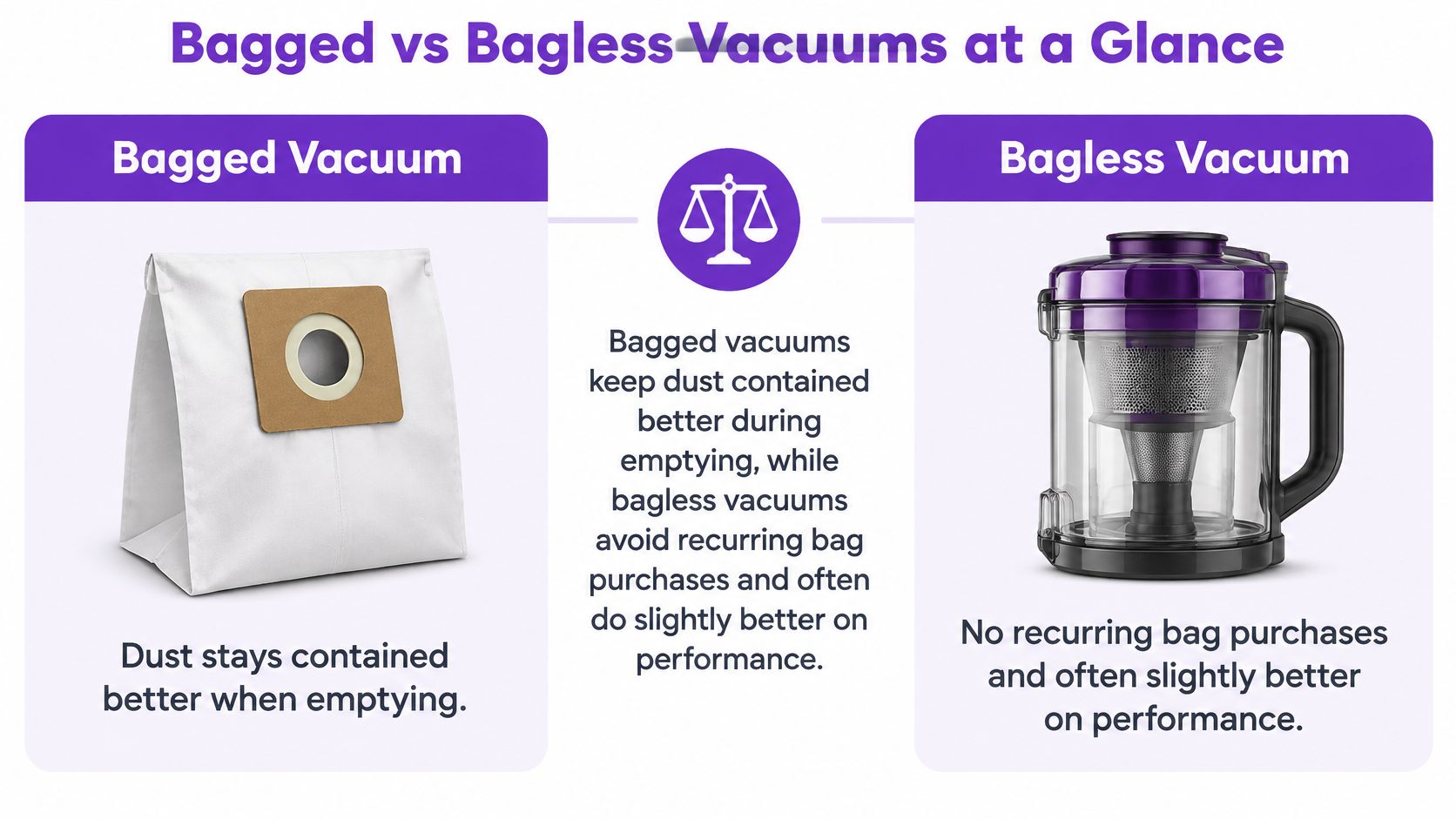
Bagged vs bagless vacuums side by side
| Factor | Bagged vacuum | Bagless vacuum |
|---|---|---|
| Dust container | Disposable bag that seals dust in | Reusable bin or cup you empty by hand |
| Recurring purchase | Replacement bags, plus exhaust filters | Filters only, often washable or replaceable |
| Dust during emptying | Lower, the bag seals dust in; in RTINGS air-quality testing, a bag cut emissions fourfold | Higher, the bin is opened and dust can escape |
| Noise | Generally quieter in the Swedish Energy Agency vacuum cleaner review | Set by each model's motor and housing |
| Carpet pickup | Slightly lower in the Swedish Energy Agency review | Slightly better in the same review |
| Suction under load | Drops as the bag fills, measured in a European technical review | Set by cyclone efficiency and filter loading |
| Share of US residential sales | Minority, per the DOE ENERGY STAR scoping data cited in the Swedish Energy Agency review | Majority, per the same scoping data |
| Best fit | Dust-sensitive households and quiet use | Reusable containers and carpet-heavy homes |
Why both formats still sell
A U.S. Department of Energy ENERGY STAR scoping report, summarized in the Swedish Energy Agency's review, states that the majority of residential vacuums sold in the United States are bagless. The same review found broadly comparable consumer-test scores for both formats, which explains why neither design has pushed the other off the market. Bagless models scored slightly better for carpet cleaning, while bagged models were quieter and re-emitted less dust.
Bagless machines grew into a mainstream category as cyclone separation matured, giving buyers a container they could empty and reuse instead of a bag they had to replace. The review also documents how power-hungry the machines of that era were: in 2008, bagless upright cleaners typically drew 1,700 to 2,000 watts, compared with 1,150 to 2,000 watts for bagged uprights. Buyers weren't only changing where the dust went. They were buying bigger motors and a bin they could see into.
That visibility cuts both ways. A clear bin shows exactly when it needs emptying, but every trip to the trash opens the dust back up, while a sealed bag trades that exposure for a recurring purchase. The table above is really a record of where each design moves the cost: bagged machines charge you in consumables, bagless machines charge you in dust exposure at the bin and in filter maintenance.
The format decides where dust goes during emptying. The filter and the seal decide how much escapes into the room.
Those are two different questions, and a shopper who answers only the first one can end up with a machine that's tidy at the bin and leaky at the exhaust.
Dust Containment and Emissions When You Empty
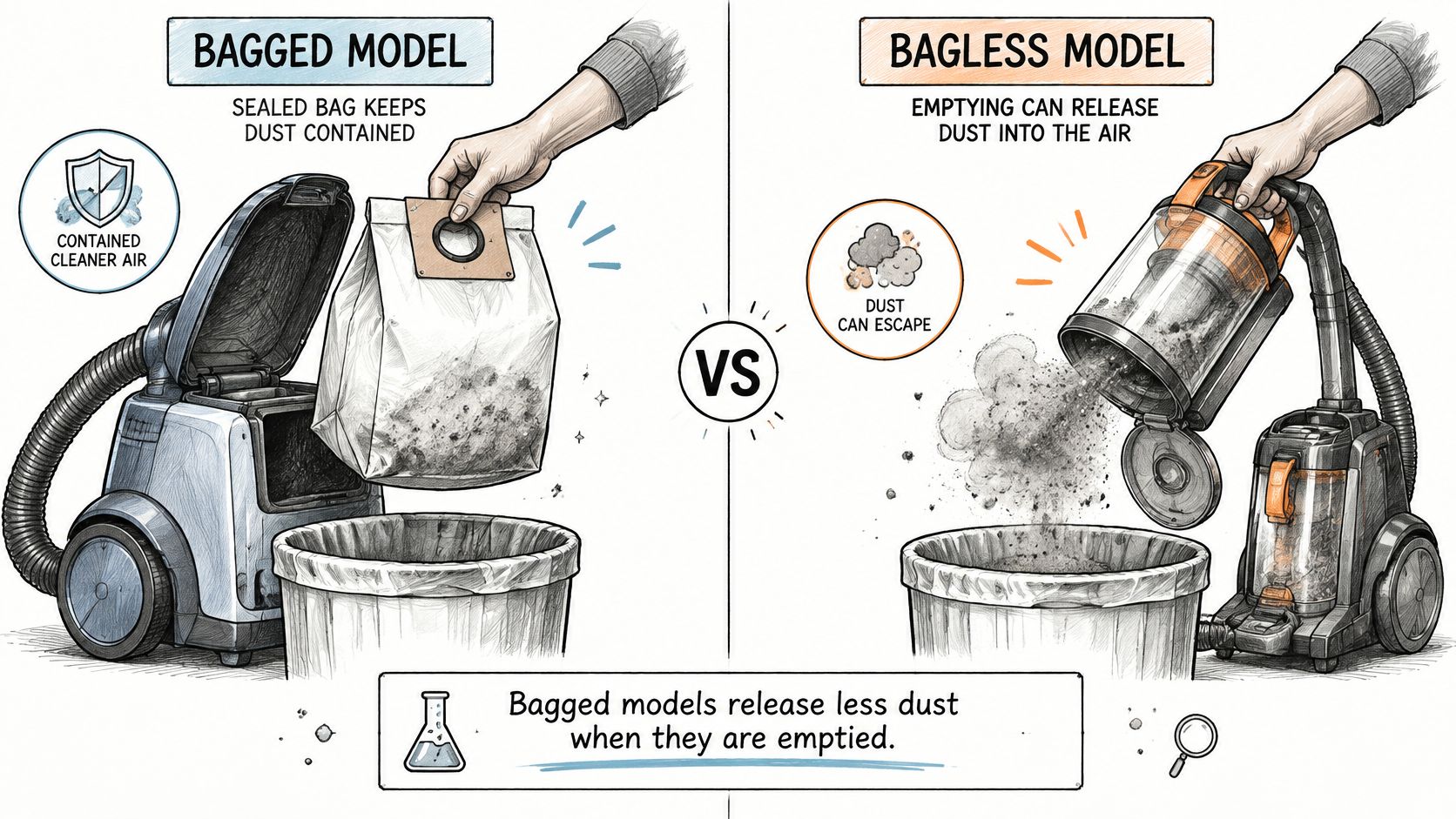
Bagged models release less dust when they're emptied. That's the clearest measurable gap between the two designs, and it shows up in laboratory air sampling rather than in marketing copy.
What the air sampling found
In an independent laboratory comparison summarized by RTINGS, 15 vacuum cleaners were tested for airborne emissions during operation and emptying. Bagged vacuums were cleaner overall, particularly while being emptied, and in one comparison the presence of a bag reduced emissions by a factor of four. The results weren't absolute. Bagless models with multiple filtration stages could hold air quality comparable to bagged machines during operation, while some lower-cost bagless models released substantially more particles.
The containment principle behind that result isn't unique to household appliances. In the same RTINGS summary, a U.S. National Institute for Occupational Safety and Health test of a dust-collector system recorded average exhaust concentration of 0.96 mg/m³ without a bag and 0.14 mg/m³ with a bag installed, roughly an 85% reduction. A bag works as a large filter surface and as a closed sack at the same time. Removing it removes both jobs.
Why the filter matters more than the format
EPA-indexed testing of 11 household vacuums, also covered in that RTINGS research, found the lowest fine-particle emission rate came from a sealed system using a HEPA filter positioned after the bag and motor. Two HEPA-equipped vacuums captured more than 99% of laboratory-generated fine particles. Position matters as much as grade, because a filter downstream of the motor catches the dust the motor itself sheds.
Running emissions and emptying emissions are separate scores, and a home can be good at one and poor at the other. A bagless machine with a sealed post-motor filter can keep room air steady for the whole session, then hand the owner a concentrated puff of dust at the kitchen bin. Households that already run air purifiers for bedroom and living-room air should treat the vacuum's emptying step as a source those units have to clean up afterwards.
A three-step emptying routine
- Take the machine outside, or at least away from bedrooms and soft furnishings, before opening anything.
- Close the bag's collar or the bin's lid before lifting the debris out, so the load drops as one mass instead of a cloud.
- Wipe the bin rim and the seal with a damp cloth before closing it, since a dusty gasket leaks on the next run.
The bagged-or-bagless label alone doesn't predict emissions. Seals, filter position and emptying technique do.
Suction and Filter Loading Over a Full Cycle
A vacuum can feel strong on the first pass and weak by the time the bag or bin is ready to empty. The drop is usually gradual, so owners often blame the carpet or floor. The cause is airflow. A bagged machine loads its bag as the main filter. A bagless machine loads the filter after the bin has spun out the bulkier debris. Both designs keep cleaning, but neither keeps the same pickup all the way through.
How each design loses airflow
In a bagged vacuum, the bag does two jobs. It stores dust and filters the air passing through it. As pores fill, resistance rises. A European technical review of vacuum cleaners states that suction power fell from 242 W with an empty bag to 227 W when full, about a 6.2% reduction. The same review gives about 18 to 25 kPa as a minimum pressure-drop range and at least 8.5 L/s of airflow with a full bag as engineering reference points.
Bagless machines behave differently. Most hair, crumbs and larger particles drop out before the air reaches a filter, so a half-full bin may matter less than a neglected pleated cartridge. Fine dust changes that pattern. Flour, plaster and sanding dust can pass deeper into the machine and load the filter media early. Pickup can fall well before the bin looks full. That is why a bagless vacuum with a clear bin can still feel weak when the filter is clogged.
The gap in the label test
EU vacuum-cleaner testing measures cleaning performance with an empty dust receptacle. The Court of Justice of the European Union acknowledged that suction performance and energy efficiency can decline as dust accumulates. That is the condition the label misses. It remains useful for standardized comparisons. It describes the first pass, not the last pass before a bag swap or filter clean.
The EU policy recommendations for vacuum cleaners set second-tier thresholds of at least 0.75 dust pickup on carpet, at least 0.98 on hard floors, and no more than 1% dust re-emission. Those are minimum levels for acceptable performance. They do not rank the strongest machine on the shelf.
Buying rule: compare airflow and sealed suction under load, not the headline wattage on the box.
Three checks follow. Read any energy label as a starting point rather than a verdict. Look for test results run with a partly full bag or bin, which some independent testers publish. Then keep the filter on its schedule, because filter care is the part of this cycle the owner controls week to week.
Running Costs and Maintenance Compared
Bagged vacuums carry a recurring bag cost. Bagless vacuums trade that for filter upkeep, bin care and, on cordless models, a battery that eventually wears out. Neither format is free to run, and the cheaper one over five years depends on the specific model rather than the category.
A three-step annual cost check
Start with bags. Divide the months of use by the fill interval for that model, then multiply by the price of the exact replacement bag listed on the seller's page. Generic bags that don't seal at the collar undo the containment advantage that made a bagged machine attractive in the first place.
Then add filters. Count how many exhaust or pre-motor filters the maker expects the owner to replace in a year, and price each one from the seller's own listing with the date it was checked. FruitPunch quotes prices from sellers alongside the date they were checked, which is the standard any reader should apply to a bag or filter price found elsewhere.
Finally, weigh repair risk. A cordless machine with no spare battery available is a machine with an expiry date, and that cost lands all at once rather than a few euros at a time.
Consumables and upkeep to check by design
| Cost or task | Bagged | Bagless | What to check |
|---|---|---|---|
| Replacement bags | Bought each time the bag fills | Not needed | Whether bags are sold for your exact model |
| Exhaust or motor filter | Needed to protect airflow and filter fine dust | Needed, often washable | Whether the filter is sealed and easy to replace |
| Bin and cyclone upkeep | Not applicable | Empty and rinse on a set schedule | Condition of the bin lid and seal |
| Battery (cordless models) | Priced by the maker, only where a spare pack is sold | Priced by the maker, only where a spare pack is sold | Whether a replacement battery is sold for the model |
| Repair access | Set by each brand's parts policy | Set by each brand's parts policy | Whether parts and service documents are published |
The filter row deserves a second look. A washable filter isn't a permanent one, since pleated media loses structure after repeated rinsing and eventually needs replacing anyway. A bagged machine's final filter stays cleaner for longer because the bag intercepts most of the load, so its replacement interval can stretch further than a bagless owner expects.
Repair access is now a policy question
The EU right-to-repair rules entered into force on 30 July 2024 and explicitly include technically repairable products such as vacuum cleaners, letting consumers request repairs under specified conditions. Repairability requirements specific to vacuum cleaners were still being developed, so coverage in law doesn't guarantee a spare hose, a service manual or a battery for any given model. Check the parts catalogue for the exact model number before buying, not the brand's reputation.
A bagless design removes one consumable stream and keeps the others. That's a real saving, and it isn't the whole bill.
Daily Convenience, Noise and Storage
Say a family with a shedding dog and a carpeted living room empties the vacuum several times a week. With a bagged model, each of those moments is a collar snapped shut and a bag dropped in the outdoor bin. With a bagless model, it's a walk outside with the bin held low over the trash, lid closed until the last second, then a rinse of the shroud once hair wraps around it.
Neither routine is hard. They fail in different ways. Bagged owners run the bag past full and wonder why pickup dropped, and bagless owners skip the filter rinse until the machine starts leaving debris behind.
Bagged machines generally run quieter and return less dust to the room, which matters in a flat with thin walls or a napping toddler. Bagless machines ask for small, frequent jobs instead of one occasional purchase, and some owners prefer that trade because nothing needs reordering.
Storage splits by body style rather than by dust format. A bagless canister with a wide cyclone stack can be taller than a bagged canister of the same bin volume, and a cordless stick lives on a wall dock instead of in a cupboard. Check bin capacity in litres and the footprint with the hose attached, since a clear bin that needs emptying twice per session isn't a convenience.
Three things to confirm before paying:
- Noise in decibels: look for a published figure measured at the operator's position, and treat a missing number as a reason to find a second source.
- Usable capacity: bag or bin volume in litres, plus whether the maker marks a fill line, because "full" is a guess otherwise.
- Tool-free access: the bag or bin should come out by hand, and a filter that needs a screwdriver will get cleaned less often.
Self-emptying docks change the arithmetic again, because the emptying step moves from the machine to a station that may itself use a bag. Readers weighing that route can compare robot vacuums with self-emptying docks on the station's consumables, not just the robot's suction.
Which Type Fits Your Home and How to Confirm It
No format wins outright. The right choice is the one whose weak point a household can live with, and every design here has one. Match the weak point to the home rather than chasing a category verdict.
Which type fits which home
| Home situation | Better fit | Why |
|---|---|---|
| Allergies, asthma or renovation dust | Bagged, with a sealed HEPA exhaust | Lower emissions during emptying in the RTINGS comparison |
| Large carpeted home with pets | Bagless | Slightly better carpet cleaning in the Swedish Energy Agency review, and no recurring bags |
| Hard floors in a small flat | Either, if the seal and filter are sound | Hard-floor results are close, so choose by the emptying routine you'll keep |
| Tight budget over several years | Bagless | No recurring bag purchases, though filters still cost money |
| Frequent emptying of dusty debris | Bagged | Dust stays enclosed in the bag during disposal |
| Cordless household | Check battery serviceability first | A worn battery can end the product's useful life |
The edge case is worth stating plainly. A bagless model with sealed, multi-stage filtration can beat a bagged model with a leaky body, because dust escapes around joints and gaskets regardless of what sits in the dust chamber. A Which? investigation into HEPA claims makes the same point from the other direction: the filter label alone doesn't guarantee allergens stay put, and models marketed with hygienic emptying systems still released dust during disposal.
A decision path that ends at the right model
- Name the top dust priority. Renovation debris and asthma point toward enclosed disposal. Pet hair on carpet points toward cyclonic separation and a rinse routine someone will keep.
- Price the exact model's consumables. Bags, filters and any battery, each from the seller's page with the date checked, added up over the years the machine is expected to last.
- Confirm parts and documentation. A published spare battery, a replaceable hose and a service manual turn a repair into an errand instead of a replacement purchase.
Cordless buyers should run step three first, not last. Our cordless vacuum comparisons treat battery serviceability as a buying criterion for that reason, since the pack decides how long the whole appliance stays useful.
The pre-purchase checklist
- Sealed system: the maker states the body is sealed, not just that a filter is high-grade.
- Filter position: the final filter sits after the motor, where it catches what the motor sheds.
- Bin or bag design: a self-closing collar or a lid that shuts before the load drops.
- Independent emissions data: test results from a laboratory rather than a claim on the carton.
- Published noise figure: a decibel number the maker is willing to print.
FruitPunch's ratings rest on each maker's documented features and published prices, not on hands-on testing, so the checklist above is designed for readers to verify the details that matter in their own home. Each product profile carries its ratings, the price copied from the maker and a short note on who should pick it, which makes side-by-side comparison faster than reading five spec sheets.
Save the checklist before walking into a store or opening a product page, and answer the five points for the two models on the shortlist. Then pick the format whose emptying routine will get followed every single time, because a sealed bag left to overfill and a filter left unrinsed both end in the same place: dust back on the floor.
FruitPunch publishes scored rankings and sourced comparisons across home products, including vacuums, air purifiers and robot cleaners, with every price copied from the seller and dated. Readers comparing bagged and bagless models can use those profiles to check consumables, filter placement and battery serviceability side by side before committing. Visit FruitPunch to see the current rankings and the figures behind them.
Cite this page
FruitPunch. (2026, November 26). Bagged vs Bagless Vacuum Cleaners: Which Fits Your Home. https://fruitpunch.ai/bagged-vs-bagless-vacuum-cleaners
Spotted an error in this guide? Email editorial@fruitpunch.ai