Guide · General
Best Affordable Blender for Smoothies in 2026: Compared
By the FruitPunch research deskUpdated November 24, 202614 min read
In short
Compare the best affordable blender for smoothies by power, cleaning, durability and price. Sourced prices and a clear pick for every smoothie routine.
The cheapest blender can be the better buy, even when a pricier model has more power. Hamilton Beach's Personal Blender with Travel Lid lists for $19.99, with a 300-watt peak-power motor and a three-year limited warranty. For occasional soft-fruit smoothies, that makes it a credible starting point, not an automatic compromise. The best affordable blender for smoothies is the one that fits the recipe, survives the routine, and doesn't make cleanup a chore.
Table of Contents
- Quick Picks for Smoothies on a Budget
- What Motor Power a Smoothie Really Needs
- Side-by-Side Specs for Budget Smoothie Blenders
- Cleaning, Noise and Blade Safety in Daily Use
- Durability and True Cost Over Time
- Which Blender Fits Your Smoothie Routine
- Confirm Your Pick Before You Buy
Quick Picks for Smoothies on a Budget
A budget smoothie blender for soft fruit, yogurt, and juice starts at roughly $20 to $35 in the United States. Machines at that level typically pair a plastic jar with a modest motor and a short list of controls, while premium countertop models run into the hundreds of dollars.
That price gap doesn't mean every smoothie needs an expensive machine. It means buyers should separate minimum blending capability from what sits above it: finer texture, more controls, and heavier-duty parts.
Quick picks by price band
| Price band | Listed price | Peak motor power | Starting pick |
|---|---|---|---|
| Entry single-serve | $19.99 | 300 W | Hamilton Beach Personal Blender with Travel Lid (51201) |
| Core budget | $29.99 | 575 to 650 W | Hamilton Beach Smoothie 10-Speed Blender (50166G) or Smoothie Blender (50192) |
| Upper budget | $69.99 | 850 W | Hamilton Beach Smoothie Smart Electric Blender (56202) |
Each listed price is quoted from the seller on the date it was checked. Treat the table as a snapshot, since sellers change prices and the seller page is the version that counts on purchase day.
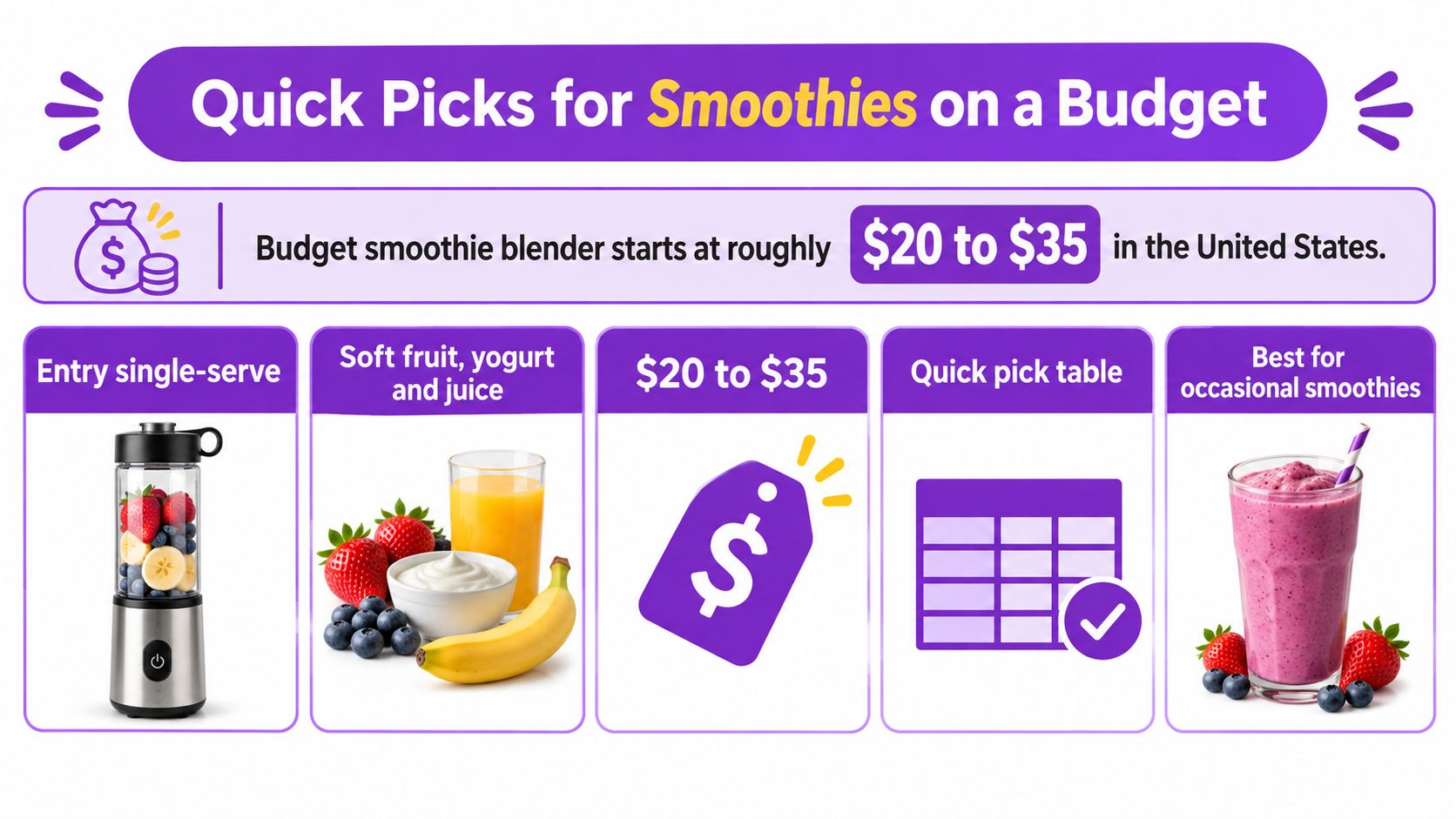
Pick a routine before a price
The entry travel blender suits occasional drinks built on ripe banana, yogurt, and enough liquid to keep ingredients circulating. A core-budget countertop model is the more sensible starting point for someone blending most mornings, particularly when the recipe includes small frozen-fruit pieces.
The upper-budget option earns its premium when ice and harder ingredients are routine. Even then, the higher motor rating is grounds for a closer look rather than a guarantee of a smoother drink.
Sticker price is also the smallest part of what a blender costs. Over three years of smoothies, the budget includes the washing-up minutes after every use, the noise level a household tolerates each morning, and the chance a light-duty machine needs early replacement. A blender bought twice erases much of the saving that made it attractive.
Shoppers replacing a blender already own the best benchmark: the machine that failed them. Naming what went wrong first, whether it was a leaking jar, gritty greens, awkward cleaning, or a motor that gave up, points at the right upgrade far better than chasing the lowest price again.
How the editorial comparison works
FruitPunch scores each product out of 10 with one weighted formula: Quality 40%, Ease of use 25%, and Value 35%. The scores compare documented features and published prices, and each product profile pairs its rating with the maker's listed price and a short note on who should pick it.
- Quality: documented blending capability and construction.
- Ease of use: controls, jar handling, cleaning effort, storage, and how livable the noise is day to day.
- Value: the published price set against features and likely ownership demands across several years of use.
The practical starting point is the price band that matches blending frequency. Model choice should then follow the hardest regular ingredient in the weekly routine, so the machine earns its counter space on ordinary days.
What Motor Power a Smoothie Really Needs
Independent testing offers a useful warning: models rated below 750 watts often struggled with tougher ingredients and produced coarser smoothies or purées, according to America's Test Kitchen's blender comparison. Its 1,200-watt Ninja Professional Plus Blender with Auto-iQ blended evenly, although the results were slightly frothier and more fibrous than those from stronger premium performers.
For frozen fruit and leafy greens, the 1,000 to 1,200-watt class is therefore a safer shopping range than an ultra-low-powered personal blender. That's a buying guideline, not a guarantee.
Peak power isn't a texture score
A manufacturer's peak-power specification doesn't establish how well ingredients circulate or how uniformly blades process them. Buyers shouldn't treat every wattage label as a directly comparable measure of sustained blending performance.
Liquid quantity matters. A thick mixture that stops circulating can leave pieces above the blades, even while the motor sounds busy. Adding a little liquid, reducing the load, or stopping to redistribute ingredients can help, provided the machine is switched off before any utensil enters the jar.
The RTINGS frozen-drink comparison identifies the Ninja Professional Blender 1000, with its 1,000-watt motor, 72-ounce jar, and pulse mode, as an option for snow-like crushed ice. Its published single-serving smoothie score is 7.3 out of 10. Pulse-based ice processing still calls for attention to ingredient distribution.
Practical rule: Buy for the hardest ingredient used regularly, not the softest ingredient shown in the product photograph.
Lower power can still be enough
The Black+Decker Quiet Blender illustrates the other side of the trade-off. The comparative testing describes it as a smaller, quieter option for ordinary smoothies, but less capable of crushing ice independently.
Whole-food blending also differs from extracting juice. When the whole fruit or vegetable stays in the jar, its pulp and fibre remain in the drink instead of being separated and discarded. That doesn't make every blended recipe nutritionally equivalent, and a finer texture doesn't prove better nutrient retention.
Before choosing a motor class, the buyer should check:
- Hardest ingredient: Soft berries, frozen mango, kale stems, and ice present different demands.
- Usual consistency: A pourable smoothie is easier to circulate than a spoonable bowl.
- Batch fit: The jar must accommodate the normal recipe without exceeding its marked fill limit.
Side-by-Side Specs for Budget Smoothie Blenders
Specs and listed prices for budget smoothie blenders
| Model | Listed price | Peak motor power | Controls and features | Warranty |
|---|---|---|---|---|
| Hamilton Beach Personal Blender with Travel Lid (51201) | $19.99 | 300 W | Single-serve, travel lid, BPA-free food-contact zones | 3 years limited |
| Hamilton Beach Smoothie Blender (50192) | $29.99 | 650 W | Stainless-steel Ice Sabre blades for smoothies and frozen drinks | 3 years limited |
| Hamilton Beach Smoothie 10-Speed Blender (50166G) | $29.99 | 575 W | Ten speeds and Wave-Action system | 3 years |
| Hamilton Beach Smoothie Smart Electric Blender (56202) | $69.99 | 850 W | Stainless-steel Ice Sabre blades for ice and hard ingredients | 3 years limited |
The wattage column reports each maker's peak-power rating, so read it as a ceiling rather than a measured working output. Two motors at similar wattage can still move a thick mixture very differently.
What the budget rows actually offer
The $19.99 travel model is the straightforward choice for one person making small, liquid-heavy drinks. Its travel lid removes the need to pour into a separate drinking vessel, and the 300-watt motor sets a clear ceiling: soft fruit and protein powder sit comfortably inside it, while heavy frozen loads belong to the bigger machines. The lid and blade area still deserve a look for cleaning access before committing.
Hamilton Beach lists the Smoothie Blender 50192 at $29.99, with 650 watts of peak power, stainless-steel Ice Sabre blades, and a three-year limited warranty. The manufacturer positions it for smoothies, protein shakes, and frozen drinks. It is a reasonable default for buyers who want a countertop machine without paying for programmes they may rarely use.
The Smoothie 10-Speed Blender 50166G carries the same $29.99 listed price with a 575-watt peak-power motor, ten speeds, and a three-year warranty. Its Wave-Action system is designed to pull the mixture toward the blades and reduce ice chunks.
At identical prices, the choice between those two is a pure feature trade-off: more advertised peak power or more manual speed control. Neither specification alone produces the smoother drink.
The Smoothie Smart Electric Blender 56202 lists at $69.99, with 850 watts of peak power and a three-year limited warranty. That works out to $40 more for 200 additional watts of peak power, and the warranty term stays the same, so the premium buys headroom for ice and hard ingredients rather than longer coverage. The listing does not establish premium-level texture or long-term durability.
When the Ninja models make more sense
The Ninja pair belongs to a higher capability bracket than the priced rows. The Professional Blender 1000, with its 1,000-watt motor, 72-ounce jar, and pulse mode, suits family-sized batches and regular ice crushing. The Professional Plus with Auto-iQ steps up to a 1,200-watt rating and trades manual speed control for preset programmes. Both wattages are reported motor ratings, so cross-brand comparisons stay approximate.
Price and warranty decide whether either Ninja counts as a budget buy, and seller prices move. Check the seller page for the current figure before ranking them against the $69.99 step-up model, because a capable machine stops being good value when its price climbs relative to close alternatives.
Price settles only the first year of ownership. Across the priced rows, the three-year warranty terms are identical, which makes power, jar size, and cleaning access the separators over the life of the machine.
Cleaning, Noise and Blade Safety in Daily Use
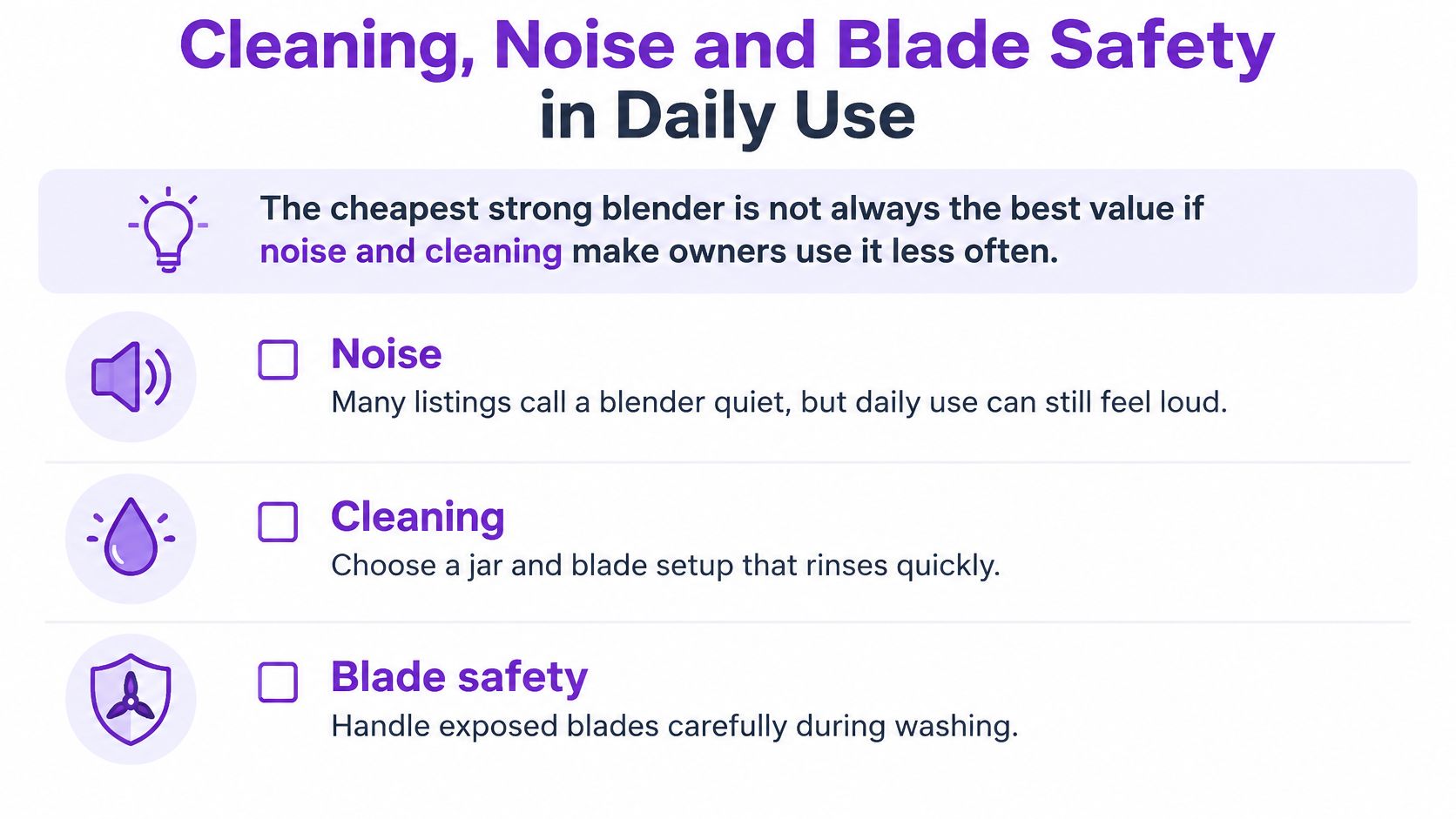
The cheapest strong blender may not be the best daily value if its noise and cleaning requirements discourage use. A machine that stays in the cupboard doesn't become economical merely because its purchase price was low.
The everyday checks are easier to remember as a short ownership checklist.
Noise needs a measurement, not an adjective
A quiet label doesn't establish how a blender will sound in a shared kitchen. The Food Network smoothie-blender review highlights practical cleaning and blade-access concerns; comparable noise and cleaning-time results aren't consistently available across recommendations.
Consumer Reports measures maximum-setting sound in decibels, but this comparison doesn't establish matched sound measurements for every shortlisted model. There's no defensible quietest winner here.
Early-morning users should look for a published sound measurement and its testing conditions. A bare decibel figure is less useful when the distance, ingredients, and operating setting aren't identified.
Cleaning effort belongs in the buying decision
Removable blades can make some areas accessible, but they also introduce exposed sharp edges and extra components. A compact travel blender may have fewer pieces than a full-size jar setup, yet fewer parts don't automatically mean easier washing.
- Count the pieces: Include the drinking lid, gasket, jar base, and blade assembly.
- Inspect access: Look for narrow recesses where thick smoothie residue could remain.
- Read dishwasher guidance: Confirm which individual components are approved, rather than assuming the whole assembly is dishwasher-safe.
- Check portability: A convenient cup still needs a lid that can be cleaned reliably.
A long brush can help clean around blades without placing fingers near the edges. The appliance should be unplugged before disassembly, and the lid should be secured as the manufacturer directs before operation.
A rinse-clean jar can be more useful than an extra blending programme.
Short tests don't establish long ownership
America's Test Kitchen's blender review describes a repeated kale-and-pineapple smoothie test conducted 10 times. That can reveal immediate performance problems, but it doesn't establish how seals, cups, or motors will behave after prolonged daily use.
A useful daily-friction record would include peak noise, hands-on cleaning time, residue after a thick drink, dishwasher compatibility, and cup portability. Until comparable results exist, those are purchase checks, not measured advantages that can be assigned to every model.
Durability and True Cost Over Time
Most short-term comparisons answer whether a blender can make a smoothie. They're less useful for predicting whether the same machine will remain leak-free, convenient, and economical throughout ownership.
That gap matters more for a daily user than an occasional one. A good initial texture score doesn't reveal the future price of a replacement jar, the availability of a seal, or the inconvenience of a failed motor.
Calculate ownership, not an imaginary lifespan
The useful calculation is:
Annual ownership cost = purchase price plus replacement and repair costs, divided by years of use.
For a three-year ownership comparison, keep the horizon the same for both candidates. This is a budgeting method, not a claim that either appliance will last that long.
| Cost-sheet item | What belongs in it |
|---|---|
| Initial purchase | Actual checkout price, including unavoidable delivery charges |
| Replacement parts | Jars, cups, lids, seals, or blades that need replacing |
| Repairs or replacement | Out-of-pocket costs not covered by warranty |
| Ownership notes | Cleaning difficulty, leaks, noise, and service interruptions |
Electricity can also be included when reliable usage and energy information are available. Advertised peak wattage alone isn't enough to calculate a trustworthy running-cost comparison.
An honest worksheet leaves uncertain costs unresolved. It doesn't assign a failure probability because one machine feels cheaper or another brand has a stronger reputation.
A warranty isn't a lifespan guarantee
A limited warranty offers protection subject to its terms. It doesn't promise uninterrupted use, cover every component automatically, or establish a minimum service life.
The important questions concern coverage and remedy. Buyers should establish whether the motor, jar, blades, and seals are covered, whether normal wear is excluded, and whether a claim requires shipping the appliance.
Replacement-part availability can change the economic outcome even when a warranty has expired. A blender with an available jar may remain usable after an accidental break; an otherwise functional machine without replacement parts may need replacing entirely.
- Check availability: Search the exact model number alongside jar, lid, seal, and blade assembly.
- Separate failure types: A cracked cup, worn gasket, and failed motor have different remedies.
- Keep records: Save the receipt, warranty terms, and seller's listed price.
- Compare equal horizons: Include the same categories of cost for both candidates.
FruitPunch compares documented features and published prices, not hands-on testing, and never claims to have bought or used a product. Its ownership-cost approach should therefore identify unknowns rather than disguise them as precise durability forecasts.
The practical conclusion is narrower, but more useful: a higher initial price is justified only when the additional capability, convenience, or support matters to the buyer's actual routine.
Which Blender Fits Your Smoothie Routine
Occasional users can start with an entry single-serve blender. There's little reason to buy a large countertop machine for a small, soft-fruit drink unless other recipes require it.
The routine comparison below uses illustrative serving sizes, not manufacturer capacity claims.
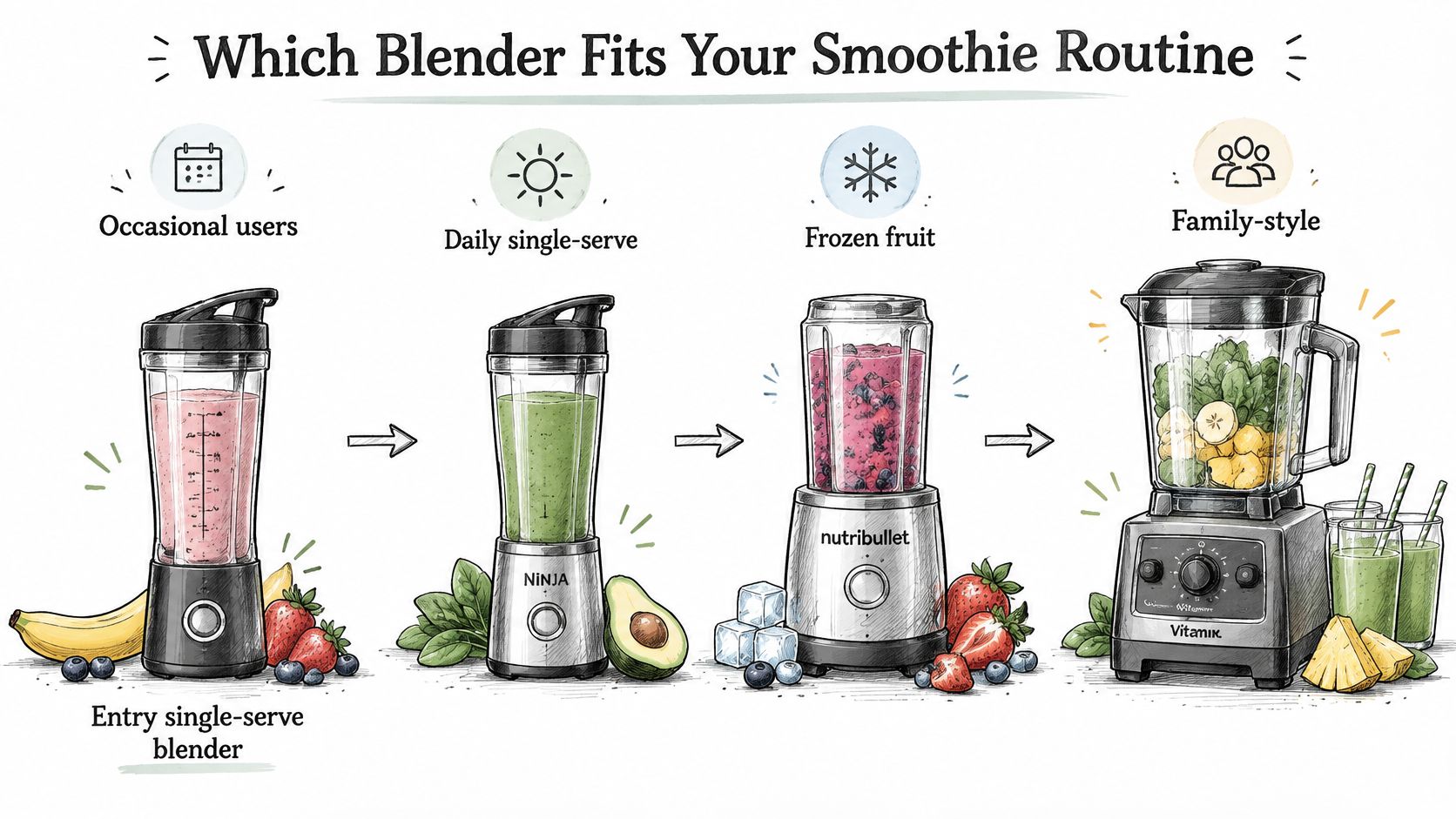
Blender tier by smoothie routine
| Routine | Typical batch | Recommended tier | Why |
|---|---|---|---|
| Occasional single serve | 1 cup | Entry single-serve, about $20 | Low wattage can handle soft fruit and yogurt with sufficient liquid |
| Daily single serve with frozen fruit | 1 cup | Core budget, 575 to 650 W, about $30 | A budget starting point, with recipe preparation and texture compromises |
| Family batches | 2 to 4 cups | 1,000 to 1,200 W with a large jar | A suitable large jar can avoid splitting the recipe |
| Heavy ice or hard ingredients | 1 to 4 cups | Upper budget, 850 W, about $70 | Ice-oriented blades and more advertised peak power |
Frequency changes the recommendation
For a daily single serving, the core-budget Hamilton Beach models are candidates rather than proven universal solutions. Small frozen pieces, adequate liquid, and removal of tough stems make a more reasonable demand than large frozen chunks or dense smoothie bowls.
Someone expecting a consistently fine green smoothie should give greater weight to published texture testing. The cheapest acceptable machine for banana and yogurt may not be the cheapest acceptable machine for kale and frozen mango.
Families should check the usable fill line, not just the jar's headline capacity. A bigger jar helps only when it safely accommodates the intended recipe and still circulates the mixture properly.
For protein smoothies, powder choice and blender choice solve different problems. Readers comparing ingredients can use the best protein powders guide, while keeping the appliance decision focused on liquid circulation, frozen ingredients, and cleanup.
Ice and early mornings create different priorities
Heavy ice users should treat an ice-crushing claim as the beginning of the evaluation. Published tests showing the resulting texture are more informative than blade branding alone.
A smaller, quieter blender may be sufficient for ordinary recipes in a shared home. Someone choosing that compromise should be comfortable avoiding recipes that depend on independently crushing a heavy ice load.
The embedded video offers an additional visual reference for smoothie preparation.
Best-fit principle: The right tier meets the everyday recipe without requiring an everyday workaround.
For frequent use, easy washing and accessible replacement parts deserve more attention than a rarely used preset. The final choice should pair the routine with a specific model, then confirm its current seller terms before purchase.
Confirm Your Pick Before You Buy
The Hamilton Beach Smoothie Blender 50192 is a sensible default for a typical budget buyer making ordinary, liquid-based smoothies. Its moderate motor specification, stainless-steel Ice Sabre blades, and limited warranty provide a clearer purchasing case than a low price alone.
That verdict has limits. It isn't a claim that this model produces the finest green smoothie, runs the quietest, or lasts longest, because the available evidence doesn't establish those outcomes.
Reasons to change the default
The Smoothie Smart is the more relevant candidate when ice and hard ingredients appear regularly. The travel blender makes more sense when compactness and occasional single servings matter more than versatility.
The Ninja alternatives deserve a closer look when larger batches or tougher recipes dominate. Their final value depends on current pricing, confirmed warranty terms, and whether the larger machine is practical to store and wash.
The best affordable blender for smoothies isn't necessarily the model with the lowest checkout total. It's the least expensive option that meets the buyer's requirements without creating predictable frustration.
The final purchase checklist
- Confirm the exact model: Similar product names can hide different motors, jars, and controls.
- Verify the seller price: Promotional pricing can change the relative value of close alternatives.
- Read component coverage: Identify what the warranty says about the motor, jar, blades, and seals.
- Inspect the cleaning setup: Count removable pieces and confirm component-specific dishwasher guidance.
- Investigate sound: Early-morning users need comparable measurements where available, not an unsupported quiet label.
- Price replacement parts: An affordable replacement jar can matter more than an accessory included at purchase.
- Record the ownership case: Note the intended recipes, likely cleaning routine, and unresolved durability questions.
A simple cost sheet should record the selected model, checkout price, warranty terms, and date checked. It should also include any known replacement-part prices, without pretending that uncertain future repairs are guaranteed.
If the price rises or the warranty changes, the decision should be reconsidered rather than defended out of habit. Buy the documented fit, not the discount percentage.
FruitPunch offers sourced product comparisons that explain what specifications, prices, and ownership trade-offs mean for everyday buyers. Visit FruitPunch to compare the shortlist and build a purchase decision around the smoothie routine, cleaning demands, and budget that matter.
Spotted an error in this guide? Email editorial@fruitpunch.ai