Guide · General
Best Entry Level Espresso Machine: Picks for 2026
By the FruitPunch research deskUpdated November 23, 202612 min read
In short
Compare the best entry level espresso machine options by usability, shot quality, maintenance and price, with a clear pick for each buyer type.
The best entry level espresso machine isn't the one with the highest pump rating or the lowest sticker price. For most beginners, the right starting point combines controlled brewing pressure, stable temperature, and a usable steam wand. The Sage/Breville Bambino Plus is the strongest starting candidate for daily milk drinks. The De'Longhi Stilosa suits tighter budgets, while the Gaggia Classic Evo Pro fits buyers who want a hands-on hobby.
The less obvious decision is financial. A machine that saves money at checkout can still demand more spending on grinding, accessories, and service. This comparison weighs daily workflow friction and ownership costs alongside documented features, rather than treating the number on the box as a quality score.
Table of Contents
- Quick Picks for the Best Entry Level Espresso Machine
- Pressure, Temperature and Shot Targets
- Warm-Up Time and Daily Workflow Friction
- Maintenance and the Real Yearly Cost
- Matching a Machine to Your Daily Routine
- Choose Your Machine and Confirm the Price
Quick Picks for the Best Entry Level Espresso Machine
The shortlist separates routines, not interchangeable bargains. Start with the drink made most often, then count the steps between filling the tank and serving it. A low sticker price helps only when the machine's daily workload stays low.
Entry-level espresso machine quick picks
| Machine | Listed pump rating | Start-up or warm-up | Best for |
|---|---|---|---|
| Sage/Breville Bambino Plus | 15-bar pump, reported about 9 bar at extraction | Rapid heating | Daily milk drinks |
| De'Longhi Stilosa EC260.BK | 15-bar vibratory pump | Model-specific timing not documented | Occasional users on a budget |
| Gaggia Classic Evo Pro | Single-boiler system | Boiler warm-up required | Learners who dial in shots |
| CASABREWS 20-bar comparison unit | 20-bar listed maximum | Model-specific timing not documented | Budget benchmark only |
The strongest fit for each buyer
Sage/Breville Bambino Plus. Its strength is assistance without abandoning hands-on espresso preparation. Coffee Nerdery's Bambino Plus profile describes a 15-bar pump extracting at approximately 9 bar, PID temperature control at about 93°C, and low-pressure pre-infusion. Its limit is puck preparation: faster heating and milk assistance reduce waiting, but grind, distribution, and tamping still decide shot quality.
De'Longhi Stilosa EC260.BK. Its strength is a forgiving entry point. Home Espresso HQ lists a 15-bar vibratory pump, manual steam wand, pressurized filter basket, and price of about $95. Treat that figure as a secondary seller-market estimate rather than a dated maker quotation, and confirm the live seller price before ordering. The pressurized basket lowers the immediate demand for precise grinding, while leaving less room to learn conventional basket-based shot adjustment.
Gaggia Classic Evo Pro. Its strength is a more deliberate preparation workflow. The single-boiler design and commercial-style portafilter suit learners who want to adjust grind, distribution, and tamping rather than delegate milk preparation. Its limit is the interruption between brewing and steaming, which becomes more noticeable when preparing drinks for a household.
CASABREWS 20-bar comparison unit. Treat it as a benchmark for what a high box number does not prove. The listed maximum does not document temperature stability, extraction control, or service support. Confirm the exact model name, seller price, and check date before comparing accessories or specifications.
What the shortlist can establish
FruitPunch product profiles show ratings, the price copied from the maker, and a short note on who should pick each product; its ratings rest on documented features and published prices, not hands-on testing. A usable shortlist needs a preferred option and a credible alternative, matched to routine before price. For budget rows, the deciding check is yearly friction: grinding demands, basket style, warm-up interruption, and service support.
Pressure, Temperature and Shot Targets
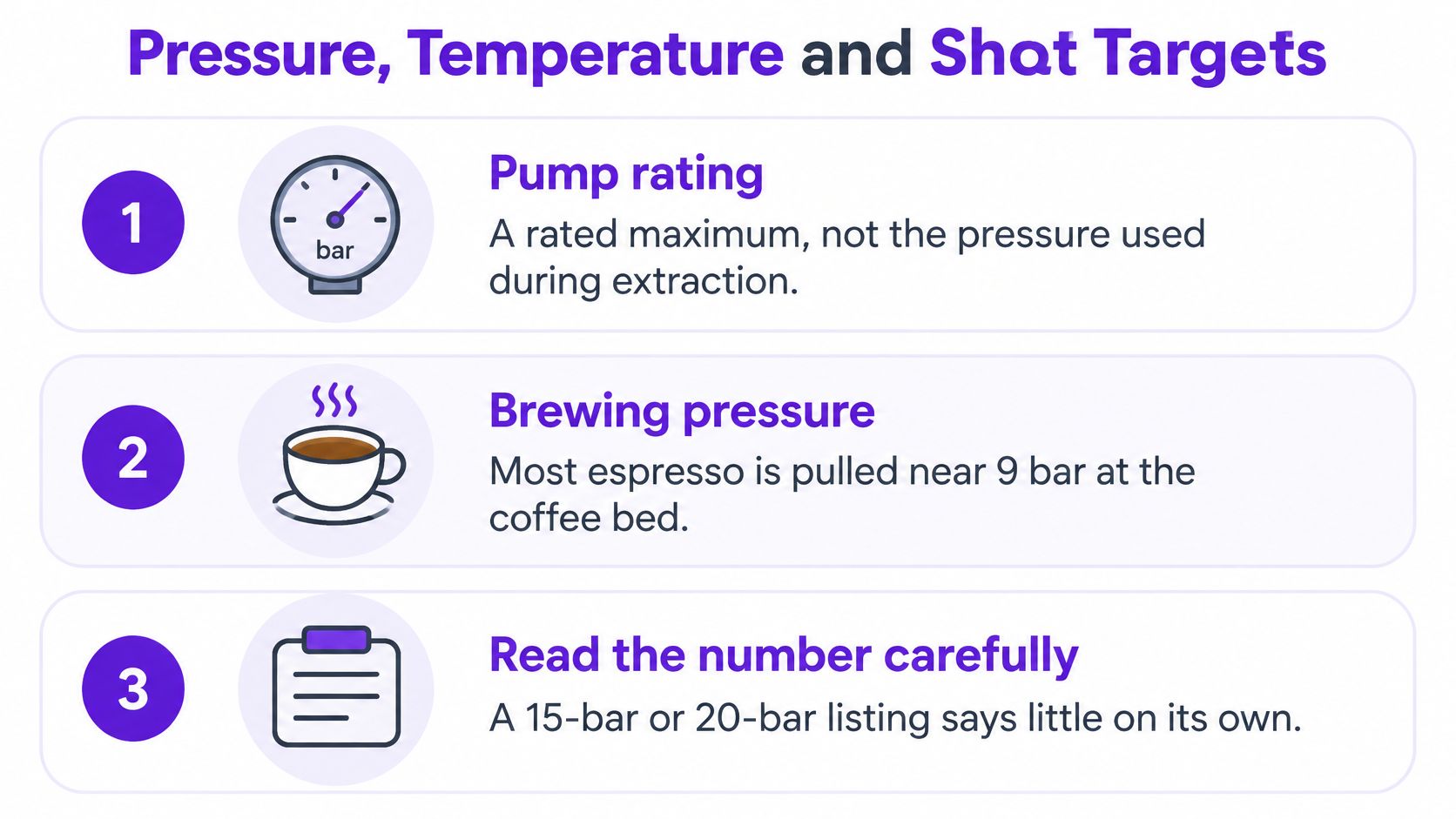
A pump rating is a rated maximum, not a measurement of brewing quality. Aesthetic Brew's machine comparison lists the Stilosa at 15 bar and the CASABREWS comparison machine at 20 bar, but those figures don't establish pressure at the coffee bed.
The distinction matters because coffee preparation depends on a controlled operating window. A larger maximum doesn't compensate for unstable heat or uneven water flow through the puck.
The checks that matter
- Pressure control. Look for an over-pressure valve or equivalent regulation. A pressurized basket creates resistance and helps beginners, but it isn't the same mechanism as regulating pump pressure.
- Temperature control. Look for PID control or credible measurements across an extraction, not just a claimed heating temperature.
- Pre-infusion. Gentle initial wetting helps saturate the puck before full brewing pressure arrives.
- Milk preparation. A controllable manual wand suits learners. Automated texturing suits buyers who value repeatability with less practice.
- Basket compatibility. Check usable doses, replacement baskets, and accessory availability.
- Service support. Establish whether the exact regional model has accessible seals, parts, and repair support.
Espresso target parameters and what to check on a machine
The following reference ranges come from the SCA-style standards summary, which describes brew water around 90.5 to 96°C, pressure around 8.5 to 9.5 bar, doses around 18 to 21 g, a beverage-to-coffee ratio near 2:1, and extraction around 25 to 30 seconds.
| Parameter | Target range | What to check on the machine |
|---|---|---|
| Brew water temperature | 90.5 to 96°C, approximately 195 to 205°F | Stability across the shot; the standards summary gives roughly ±1°C |
| Brew pressure | 8.5 to 9.5 bar, approximately 9 bar standard | Actual regulation, rather than the pump maximum |
| Coffee dose | 18 to 21 g | Whether the basket accommodates the intended dose |
| Liquid-to-coffee ratio | About 2:1 | Repeatable beverage weight measured with a scale |
| Extraction time | Approximately 25 to 30 seconds | Consistent timing with an appropriate grind and preparation |
These are starting parameters, not a universal recipe. Basket capacity, coffee, and taste still govern adjustment.
Temperature drift can change the verdict
Balance Journal's published comparison reports a Gaggia Classic Evo Pro average near 93.3°C, with about 2°F of variation, while a Smeg ECF01 test began at 95 to 96°C and fell below 90°C during a 25 to 30-second extraction. The same comparison identifies the Gaggia's 58 mm portafilter and solenoid-assisted cleanup, and reports Bambino Plus heating in under three seconds.
Those observations explain why heater labels alone aren't enough. Buyers need to know what happens while coffee is brewing, not merely when an indicator light appears.
Practical rule: A controlled extraction is more useful than an impressive maximum-pressure specification.
At home, a scale and timer can establish yield and repeatability. Actual pressure and temperature claims require suitable measurements; taste alone can't identify the cause of every sour or bitter shot.
Warm-Up Time and Daily Workflow Friction
Fast heating and fast drink preparation aren't the same thing. Complete Home Barista's warm-up guide gives general brewing-temperature ranges of about 30 to 60 seconds for thermoblocks and about 5 to 10 minutes for single-boiler machines. Product-specific instructions take priority because these are equipment-type ranges, not guarantees.
A heating-ready indicator also doesn't necessarily establish that the portafilter and cup are warm. Buyers should distinguish the advertised start-up milestone from the full preparation routine.
Warm-up and workflow by heater design
| Heater design | Typical time to brew temperature | Main workflow trade-off | Best for |
|---|---|---|---|
| Thermoblock | About 30 to 60 seconds, general range | Fast start; repeated steaming capacity needs checking | A quick individual drink |
| Single boiler | About 5 to 10 minutes, general range | Switching between brewing and steaming | Patient users making a small round |
| Bambino Plus, reported | Under three seconds in the published comparison | Automated milk texturing; smaller proprietary accessories | Daily milk drinks |
| Dual boiler | Model-specific; verify the maker's stated readiness | Separate brewing and steaming systems, with more equipment to maintain | Households prioritizing consecutive milk drinks |
The Bambino Plus entry describes the reported model-specific heating claim, not a promise that a finished drink takes that long. Grinding, dosing, brewing, milk preparation, and cleanup still take time.
A commuter and a household need different things
A commuter making a straight espresso before work benefits from a short start-up and an uncomplicated cleanup. A thermoblock can fit that pattern, provided the basket and grinder don't introduce an unwanted preparation ritual. A simple pressurized-basket machine can also be sensible when convenience matters more than detailed adjustment.
A household preparing a round of milk drinks needs a different comparison. Steam recovery, tank access, and the transition between brewing and steaming matter more than the first readiness light. A machine that seems quick for an isolated espresso may feel slow when every drink requires another change of operating mode.
A learner may willingly accept waiting. Warm-up becomes less important when preparation includes weighing beans, adjusting the grinder, and recording results.
Count the tasks outside brewing
- Water access. Check whether the tank lifts out under the intended cupboard.
- Cleanup. Include emptying the basket, rinsing the portafilter, and wiping and purging the wand.
- Morning noise. Consider the grinder as well as the pump.
- Convenience alternatives. A Nespresso Vertuo Pop comparison offers another route for buyers who don't want manual puck preparation.
The useful timing exercise begins at the power button and ends after cleanup. A buyer's available morning window should govern the choice, not the shortest heating claim.
Maintenance and the Real Yearly Cost
The cheapest machine at checkout isn't necessarily the cheapest machine to own. A meaningful comparison includes grinding, water treatment, cleaning, electricity, and access to repairs.
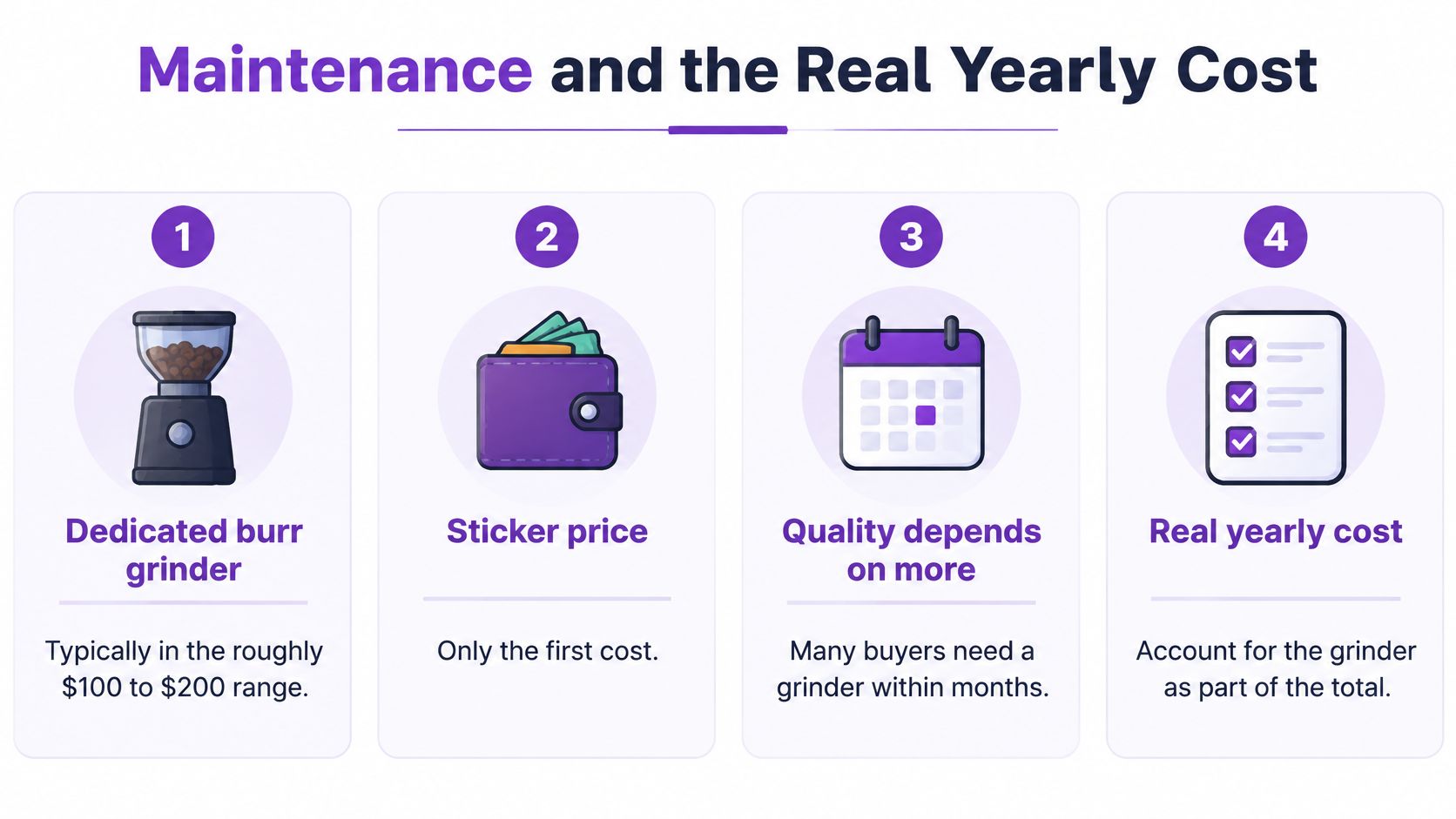
The Ember & Cole espresso ownership guide places a dedicated grinder in the roughly $100, $200 range and describes cleaning and descaling schedules ranging from roughly monthly to every few months, depending on water hardness. Those figures are broad planning references, not quotations for a particular grinder or maintenance contract.
Annual ownership cost components
| Cost item | Typical range or timing | Notes |
|---|---|---|
| Dedicated burr grinder | Roughly $100, $200, one-time planning range | Can improve consistency over many built-in grinders |
| Descaling | Roughly monthly to every few months | Set the schedule using water hardness and machine instructions |
| Cleaning supplies and filters | Replenish according to use and filter instructions | Recurring cost |
| Gaskets and shower screens | Replace when worn or damaged | Include parts and any service labor |
| Electricity | Calculate from consumption and the local tariff | Usage and regional prices determine the total |
| Repairs and parts | Obtain model-specific local quotations | Parts access and service availability matter |
A complete numerical annual ranking isn't defensible without current machine prices, local consumable costs, and usage assumptions. Unknown costs shouldn't be treated as zero.
Build a comparable ownership estimate
- List the equipment and recurring items. Include the machine, grinder, scale, needed accessories, water treatment, detergent, filters, and a repair allowance. Separate items already owned from new purchases.
- Estimate drinks consumed. Use the household's normal routine, not an optimistic plan to replace every café visit. Keep practice shots and wasted coffee in the spending estimate.
- Divide comparable totals by completed drinks. Calculate a first-year total with upfront purchases included. Then calculate a later-year total without charging for the same equipment again.
For a clearly hypothetical example, a $150 grinder used across 300 drinks adds $0.50 per drink in the first year, before consumables. That is arithmetic, not a quoted grinder price or a predicted household drinking volume.
Service changes the value calculation
Before choosing a machine, buyers should establish the regional voltage, warranty coverage, and availability of replacement seals and screens. An attractive imported price can lose its appeal when local technicians won't service the model.
Coffee spending also belongs in a complete household comparison. The coffee subscription services guide can help assess bean purchasing alongside equipment costs, without confusing optional delivery convenience with a machine requirement.
A repairable machine can be the better bargain even when its checkout price is higher.
The contrarian conclusion is straightforward. A cheap machine becomes expensive if it requires an immediate grinder purchase that wasn't budgeted for, or if a minor fault leaves no practical repair route.
Matching a Machine to Your Daily Routine
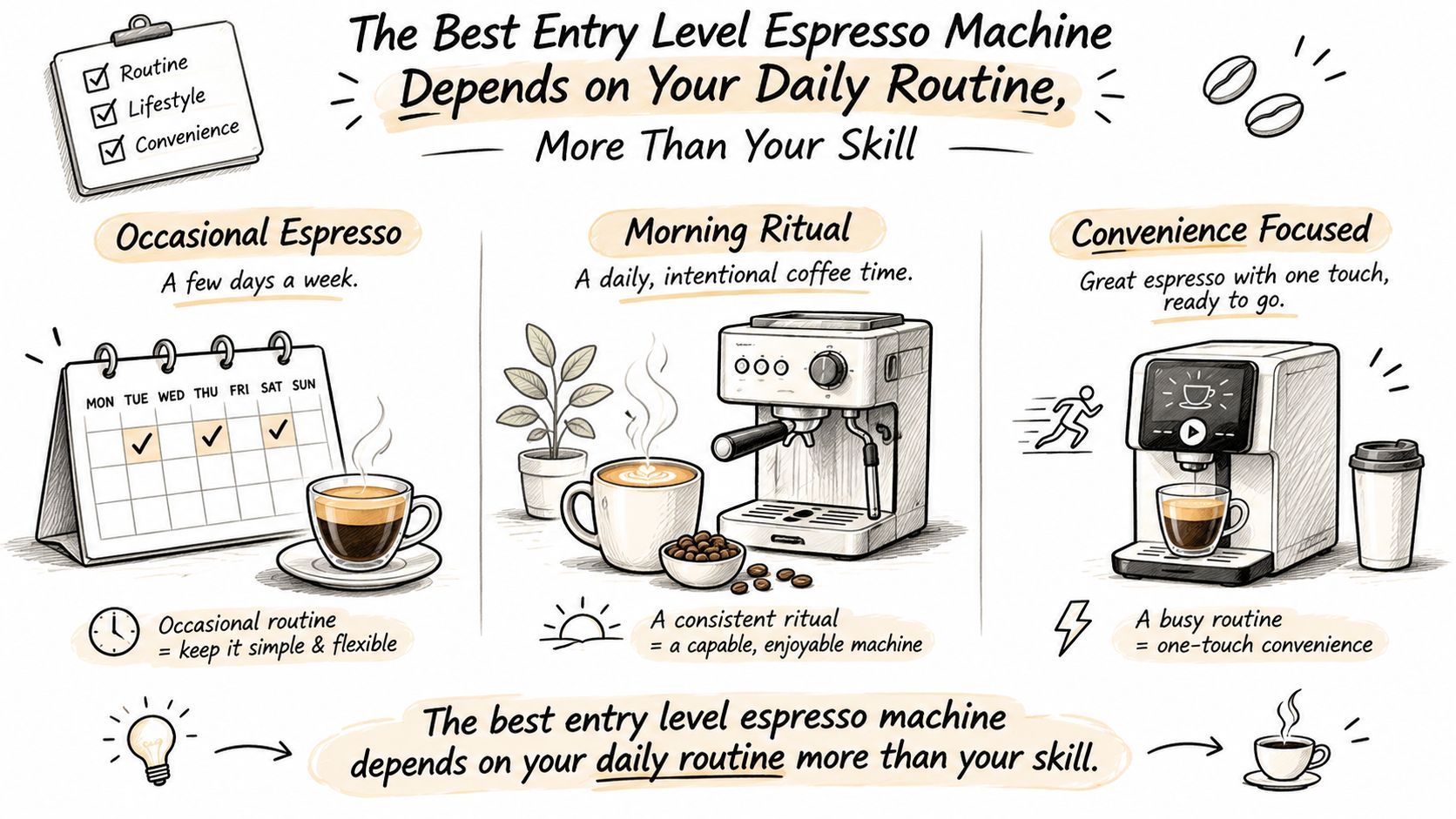
Buyers differ more in their routines than in their potential to learn. A machine should fit the work its owner wants to do, not the identity suggested by its marketing.
Coffee Gear Hub's beginner guide emphasizes a fine, consistent grind and careful adjustment. That requirement helps explain why a beginner-friendly machine can still frustrate someone who expects the appliance to make every preparation decision.
Routine-based machine choice
The volumes below are illustrative buying scenarios, not measured consumer averages.
| Routine | Typical volume | Machine type that fits | Main trade-off |
|---|---|---|---|
| Occasional espresso | One or two drinks a week | Simple pressurized-basket machine | Less control over shot dialing |
| Daily milk drinks | Two or more drinks each morning | Automated-milk machine with fast start | Less manual involvement; accessory compatibility needs checking |
| Hands-on learner | Daily practice time | Single-boiler machine with a dedicated grinder | Learning curve and grinder cost |
| Convenience first | Several drinks with little preparation time | Fully automatic or pod system | Less shot control; running costs require comparison |
Accept the right inconvenience
Occasional espresso drinkers can accept limited adjustment if the machine remains straightforward to use. The Stilosa's basket approach fits that compromise. What they should refuse is a maintenance or preparation burden so large that the machine stays unused.
Daily milk-drink households can accept automated texturing and less hands-on control. The Bambino Plus is a logical candidate for that preference. What they should refuse is a workflow that requires repeated delays beyond the household's available morning time.
Hands-on learners can accept a learning curve and a separate grinder. The Gaggia Classic Evo Pro fits an interest in repeatable puck preparation and deliberate adjustment. What they should refuse is buying accessories before checking compatibility or assuming an expensive machine will correct poor grinding.
Convenience is a legitimate goal
A pod or fully automatic system isn't a failure to appreciate espresso. It's a different purchase decision. Buyers who dislike dosing, tamping, and handling wet grounds may get more value from a system they use consistently.
The trade-off is reduced direct control over extraction. Pod costs can also outweigh savings on equipment, while fully automatic machines have their own cleaning requirements. Neither category should be described as maintenance-free.
Decision test: The right machine supports the owner's normal week, not an imagined weekend café routine.
A broader coffee maker comparison is useful when espresso itself isn't essential. Someone who mainly wants an easy mug of coffee may be comparing the wrong appliance category.
The strongest shortlist starts with a candid description of the intended habit. Learning enthusiasm, milk-drink demand, and tolerance for cleanup should be explicit before a model becomes the favorite.
Choose Your Machine and Confirm the Price
A purchase is ready when the buyer can explain the machine's role, its compromises, and its likely ownership costs. A discount alone doesn't answer those questions.
FruitPunch ratings rest on each maker's documented features and published prices, not on hands-on testing. This comparison likewise distinguishes published specifications and reported observations from direct product testing.
A practical purchase sequence
Name the main routine. Occasional straight espresso, household milk drinks, deliberate practice, and convenience-first coffee are different jobs. The dominant routine should decide which compromises are acceptable.
Keep a preferred machine and a runner-up. The Bambino Plus fits assisted milk preparation. The Stilosa fits a simpler budget entry point, while the Gaggia suits deliberate learning. CASABREWS needs an exact model match and fuller documentation before it can move beyond a comparison candidate.
Verify the extraction features. Read the exact regional model documentation for pressure control, heating, baskets, and milk operation. A feature mentioned for a related model shouldn't be assumed to exist on the product being purchased.
Calculate comparable ownership totals. Include a grinder when needed, but don't charge an existing suitable grinder as a new purchase. Add required accessories and recurring maintenance before comparing value. Keep unknown repair costs visible rather than inventing a precise annual figure.
Confirm the seller's current offer and record the check date. Save the model number, included accessories, price, warranty terms, and return conditions. Verify local service and replacement-part access before payment, especially for imported equipment.
Make the decision on the whole setup
A learner comparing the Gaggia with a pressurized-basket machine should price the complete intended setup for each. The relevant question isn't whether the more involved machine has greater potential. It's whether the buyer wants to spend the time and money required to use that potential.
Likewise, a daily latte drinker shouldn't choose a slower workflow merely because another machine appears more traditional. A feature has value only when it improves the owner's actual preparation routine.
The final choice should satisfy routine fit, a credible shot-quality profile, and an affordable ownership total. If the preferred machine's price rises, the runner-up should remain a genuine alternative rather than an afterthought.
FruitPunch is an independent publication offering product comparisons, sourced statistics, and explanatory buying guides. Visit FruitPunch to compare coffee equipment and other household purchases with documented features, clear trade-offs, and price context.
Spotted an error in this guide? Email editorial@fruitpunch.ai