Guide · General
Best Month to Buy Mattress in 2026: Sales Calendar
By the FruitPunch research deskUpdated November 21, 202611 min read
In short
Best Month to Buy Mattress: May and November lead US sales, with Labor Day and January close behind. Learn how to judge real mattress discounts.

For US shoppers, May and November are typically the strongest months to buy a mattress, with Memorial Day offers in May averaging 37.6% off among verified promotional codes and November matching it as one of the two highest-discount months of the year. September and the January to February window come close behind, and the size of the saving depends on the brand, the model and the price a discount is measured against.
The calendar most shoppers picture doesn't match the calendar that saves them money. Mattress retail runs on a busy season, a clearance season and a holiday season, and the three don't line up neatly. A shopper who waits for the loudest sale of the year can easily pay more than one who buys during a quieter, transparent promotion on a model they want.
Table of Contents
- Best Month to Buy a Mattress at a Glance
- Holiday Windows and the Busiest Month Myth
- Early-Year Dips and Spring Clearance Patterns
- Checks That Separate Real Discounts From Marketing
- When Waiting for a Sale Costs You More
- Confirm the Price Before You Buy
Best Month to Buy a Mattress at a Glance
Published tracking for the US market points the same way each time. May and November sit at the top, September follows, and then the early-year stretch from January to February.
Discount tracking across more than 150 mattress brands found that Memorial Day offers in May averaged 37.6% off among verified promotional codes, while premium brands commonly advertised reductions of 20% to 35% from suggested retail prices, according to SimplyCodes' analysis of mattress sale timing. The same tracking lists November alongside May as one of the two highest-discount months.
May is often the best single month for broad spring promotions, and November is equally competitive for anyone willing to wait for year-end events.
Mattress sale months and reference discounts (US)
| Month | Main event | Reference discount | Best for |
|---|---|---|---|
| January | Post-holiday price dip on tracked Amazon mattresses | 3.4% below typical annual price | Price-focused shoppers |
| February | Presidents' Day weekend; cheapest tracked week February 9 to 15 | 3.2% below typical for the month; 7.1% below average in the cheapest week | Early-year deal hunters |
| March and April | Outgoing models cleared before new releases | Clearance pricing, no fixed percentage | Shoppers who accept fewer options |
| May | Memorial Day sales | 37.6% average off verified codes | Broadest spring promotions |
| July | Fourth of July; July to September highest sales volume | No published month-level figure | Wide selection, not guaranteed deepest discounts |
| September | Labor Day sales | Around 20% to 25% off | Shoppers wanting a deal before the holiday season |
| November | Black Friday and Cyber Monday | One of the two highest-discount months | Patient shoppers |
| December | Year-end clearance | No published percentage | Shoppers checking for leftover stock |
The January and February rows come from a price-tracking study of Amazon listings rather than the promotional-code analysis, so those percentages measure each mattress against its own typical annual price instead of against a list price. Read the table as a set of benchmarks, not a like-for-like ranking. A code-based average of 37.6% and a 3.4% dip against an annual average aren't the same kind of number, and neither one predicts the price of the model in front of you.
Treat a month as the starting point, then open the seller's page and check the actual price of the specific model on the day you plan to buy. FruitPunch's mattress rankings score models on quality, ease of use and value, which narrows a wall of holiday banners down to a shortlist worth pricing.
Holiday Windows and the Busiest Month Myth
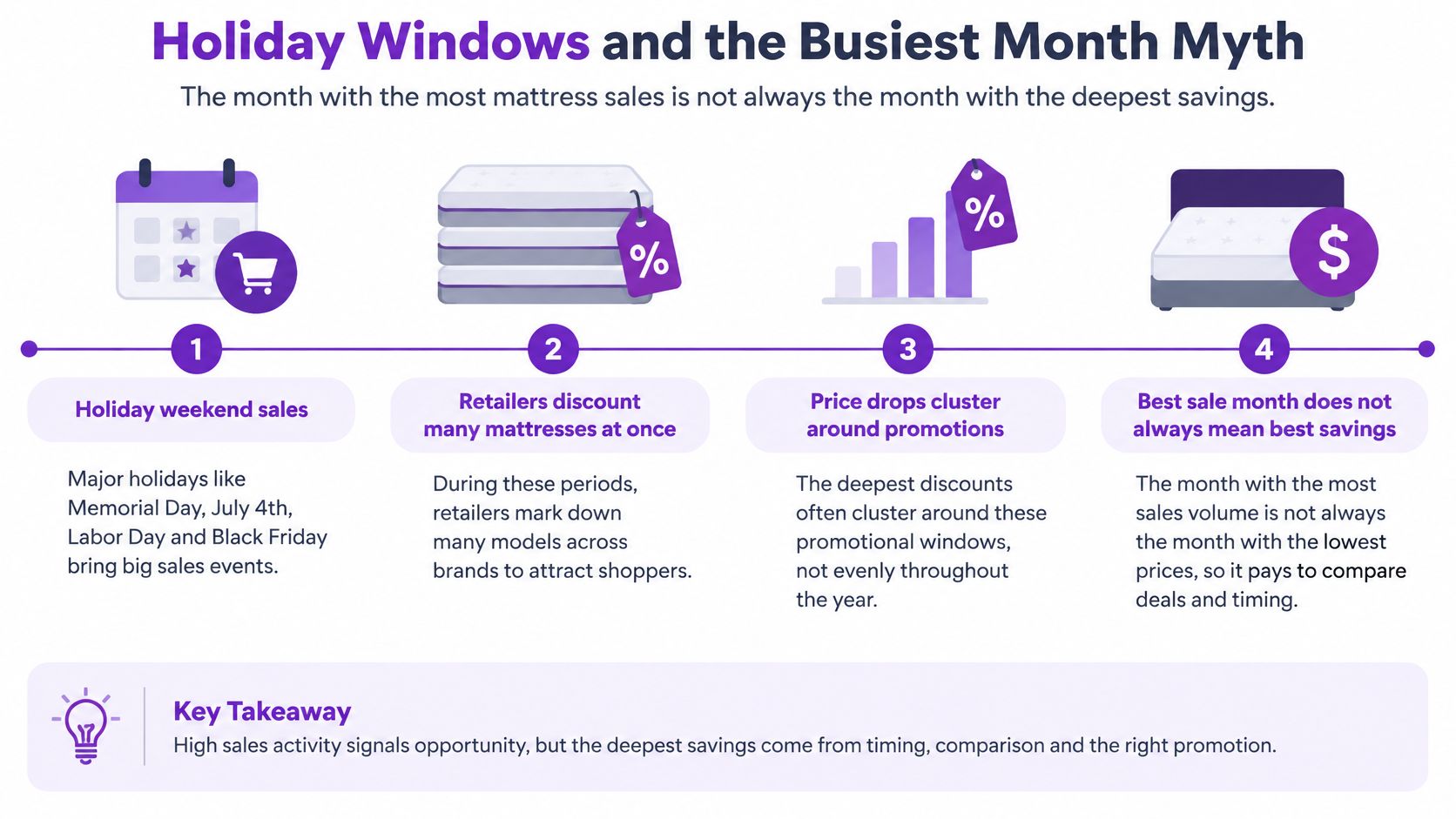
The busiest stretch for mattress sales and the cheapest stretch rarely fall in the same month, and shoppers conflate the two constantly.
Holiday weekends trigger catalogue-wide markdowns. Retailers clear a whole range at once, the way a shop hangs one banner over an entire aisle. Sleep Foundation identifies Presidents' Day as the first major mattress-sales holiday, with discounts commonly running through the three-day weekend, and notes that Memorial Day promotions often begin about a week before the holiday while Labor Day promotions may also start during the preceding week (Sleep Foundation's guide to mattress sale timing).
That clustering is the mechanism behind the myth. Retailers concentrate broad, model-level promotions on those weekends rather than shaving a little off a few individual products at random. It also means a transparent sale with a clear starting price and a stated end date can beat waiting for a nominally bigger event, because the size of the banner says nothing about the margin given up.
The timeline below shows how a holiday weekend turns into a catalogue-wide markdown, and why a big sale month isn't automatically a cheap one.
Why Volume and Discount Move Separately
Industry commentary cited by NerdWallet reported that July through September consistently had the highest mattress sales volume, and named Presidents Day, Memorial Day, July Fourth and Labor Day as periods when a larger share of the market is discounted at once (NerdWallet's guide to buying a mattress). Volume measures how many people are shopping. Discount depth measures how much margin a retailer gives up. Those are different decisions, made by different people, on different days.
The distinction that matters: the month that moves the most units can still be an average month for consumer savings.
What That Means for July and September
Labor Day in September suits shoppers who want a major promotion before the November cycle. Published tracking treats it as a substantial markdown event, and some retailers go further on clearance or bundled value. July earns a place on the calendar because Fourth of July promotions and extended summer campaigns overlap, but the available evidence doesn't show July is more consistently discounted than May or November.
High volume and deep discount can coincide. They just don't have to, which is why the calendar needs a second check beyond the banner.
The workable rule is to check the retailer's calendar about a week before each holiday weekend, since model-level offers tend to appear just before it starts. Then price the same specification at two or three sellers.
Every benchmark in this section is US-based. Shoppers in other markets should work from their own retail calendar, because Memorial Day, Labor Day and Black Friday carry different weight outside the US, and local chains often run clearance cycles tied to their own seasons.
Early-Year Dips and Spring Clearance Patterns
The first half of the year holds two different kinds of opportunity. One is a measurable price dip in January and February. The other is a clearance period in March and April that never shows up as a tidy percentage.
The Early-Year Dip Is Real but Small
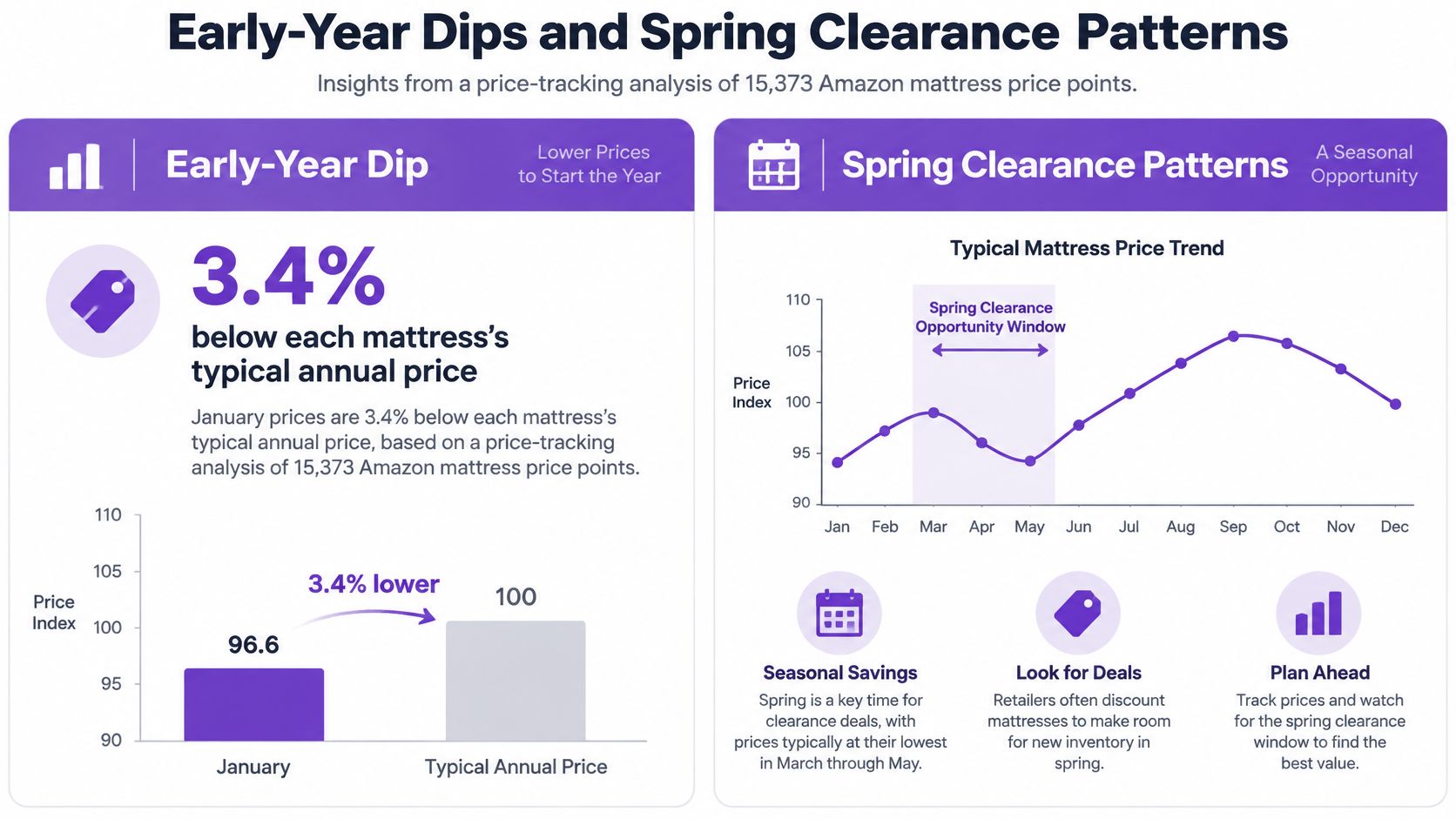
A price-tracking analysis of 15,373 Amazon mattress price points found that January prices were 3.4% below each mattress's typical annual price, while February prices were 3.2% below typical levels, according to Thrifle's mattress price tracking. The cheapest tracked week was February 9 to 15, when the median mattress sold for 7.1% below its average price.
The sample matters. Those mattresses were tracked from June 2025 through June 2026, which makes the figures a defined Amazon sample rather than every retailer or market. The percentages are modest because each mattress is measured against its own baseline across the year, a stricter test than a holiday discount measured against list price.
Two panels below show the early-year dip and the spring clearance window side by side.
Clearance Falls for a Different Reason
When brands release new models in late winter and early spring, older stock gets marked down to clear floor space. The price drops because the model is being replaced, not because a holiday arrived. No single study captures that as a percentage, since the markdown depends on how much of the outgoing line a store still holds and how quickly it wants the space back.
The trade-off is selection. A shopper who needs a particular firmness, size, colour or accessory bundle may find it gone, and floor samples come with their own condition questions worth asking before paying.
Which Window Fits Your Purchase
- Model first: look in February, when Presidents' Day promotions overlap with the early-year price dip.
- Price first: watch March and April and accept a narrower menu, because the discount is compensation for fewer options.
- Neither urgent: wait for May, where the broadest verified discounts sit.
Working rule: a specific model at a fair price in February beats a vague promise of a bigger percentage in May.
Checks That Separate Real Discounts From Marketing
The most common trick in mattress pricing is a percentage off an inflated list price. A deep-looking banner means nothing until you know the base price and whether anyone pays it.
List prices drift, bundles carry invented values, and delivery charges appear late in the checkout. The advertised percentage is usually the least reliable number in the deal. These six checks compare what a shopper pays.
Checks to run before buying a mattress on sale
| Check | What to compare | Red flag |
|---|---|---|
| Price basis | Final delivered price against the normal selling price | Discount measured only against an inflated list price |
| Warranty | Length and coverage, especially for sagging | Warranty shorter than the sale period, or loaded with conditions |
| Trial period | Length, return shipping and any return fees | No trial, or fees deducted from the refund |
| Bundles | Pillows, sheets and protectors valued at real retail | Accessories with inflated values padding the discount |
| Delivery | Whether delivery and old-mattress removal are free | Delivery charged only after checkout |
| Model status | Whether the model is current or a clearance model | Discontinued model not disclosed on the offer |
Run the rows in order, because the first one catches most of the problem. A sale that looks weaker on paper can still win on the total.
- Price basis: the crossed-out figure is a marketing number. The retailer's normal selling price is the benchmark that matters, and it's easy to check by watching the same model for a week before the sale.
- Warranty: sagging is the failure most likely to end a mattress's life early. A warranty that excludes it, or that shrinks after the sale window, shifts the risk back to the buyer.
- Trial period: a long trial with paid return shipping isn't worth the same as a shorter one with free pickup. Read who pays before ordering.
- Bundles: price the pillows and protector separately at a store you trust. Inflated accessory values are the easiest way to widen a thin discount.
- Delivery: confirm whether delivery, setup and old-mattress removal are included before checkout, since a delivery fee can wipe out a modest percentage.
- Model status: ask directly whether the model is current or being discontinued, and get the answer onto the order confirmation.
Two habits protect the decision. Screenshot the offer with the date and the exact model name, size and firmness, then price the same specification at two other retailers. Makers change prices often, so the seller's own page is the only reliable source on the day of purchase. FruitPunch copies prices word for word from the seller and records the date each was checked, which is the habit worth copying.
When Waiting for a Sale Costs You More
The best month isn't automatically the right month. A mattress that's already wrecking sleep charges a fee every night, and no holiday discount repays it.
Market conditions cut both ways. US industry data show mattress unit shipments fell 13.2% in 2025 while market value declined only 6.5%, meaning buyers purchased fewer units while spending per purchase held up (Everchem's US mattress industry overview). Weak volume can push retailers toward promotions. It doesn't guarantee a lower net price in November, because a seller can protect margin with bundles, selective markdowns or a quiet change in what's available.
The Model You Want May Not Survive the Wait
Brands commonly release new products in late winter and early spring, and older models get marked down to make room, which is why CBS News recommends checking retailer and brand sites in March and April for possible clearance prices (CBS News guide to mattress sale timing). That timing helps a flexible shopper and hurts a fixed one. The clearance arrives, but the firmness, size or colour on the wish list may already be gone.
A Three-Question Decision Sequence
- Is the current mattress affecting sleep or health? If yes, buy now at a transparent price. Waiting turns a purchase decision into a nightly discomfort budget.
- Will the exact model still be available later? If not, buy when the offer passes every check rather than risking a replacement.
- Is there a concrete reason to wait? A known holiday sale or a spring clearance counts. A vague hope for a bigger banner doesn't. Set a price alert and a deadline with it.
A good purchase in a transparent sale can beat waiting months for a nominally deeper discount. The shopper who buys then stops paying attention to the calendar.
For a second pass over that decision, the short overview below covers the main points.
Confirm the Price Before You Buy
Three actions turn a sales calendar into an actual purchase.
- Pick the window that matches your urgency. May or November for the broadest deals, September for a pre-holiday option, February or March to April when price or one specific model matters most.
- Set a price alert on the exact model and write down today's price with the date. That saved figure is the benchmark, and it's the only thing that makes a later "sale" comparable.
- On the day you buy, open the seller's own page. Confirm the final delivered price, warranty, trial period and bundle value against the checklist, then compare the total with the saved benchmark. Buy when it matches or beats it.
If recovering part of the spend matters too, FruitPunch's comparison of cashback shopping sites covers the services that return a share of what a shopper pays.
The best month to buy a mattress is a starting point, not a verdict. The final, transparent price is what decides the purchase.
FruitPunch publishes scored rankings, sourced statistics and plain explanatory guides for purchases like this one, with prices quoted from the seller and the date each check was made. If a shortlist is ready and the next step is comparing models on quality, ease of use and value, the rankings at FruitPunch put those scores in one place. Start there before the next sale weekend opens.
Spotted an error in this guide? Email editorial@fruitpunch.ai