Guide · General
How to Size a Dehumidifier: Pints Per Day Chart
By the FruitPunch research deskUpdated November 28, 202610 min read
In short
Learn how to size a dehumidifier by room area and dampness. Get the pints-per-day chart, a worked example and the checks that confirm the right capacity.
Under 2,000 square feet, the answer is 20 to 30 pints per day for slight-to-moderate dampness, 25 to 40 pints per day for very damp conditions, and 30 to 50 pints per day for wet conditions. Over 2,000 square feet, the floors rise to 30+, 40+ and 50+ pints per day for those same three moisture levels.
Those numbers come from a chart with two axes, not one. Floor area sets the row. The dampness of the space before anyone switches a machine on sets the column, and the column can move the answer as much as the square footage does. A basement that smells musty in July and a basement with water seeping through the block wall are not the same job, even though a tape measure can't tell them apart.
Table of Contents
- The Dehumidifier Sizing Chart for Area and Dampness
- How to Measure Your Space and Moisture Level
- What the Pints-per-Day Label Really Means
- Special Cases and Common Sizing Mistakes
- Compare Models on Specs Before You Buy
The Dehumidifier Sizing Chart for Area and Dampness
Two variables decide the size: the area of the space and its moisture condition before dehumidification. ENERGY STAR's dehumidifier guidance builds its recommendations on exactly those two inputs and splits the area question at 2,000 square feet.
| Room area | Slight to moderate dampness (50 to 75% RH) | Very damp (75 to 90% RH) | Wet (90 to 100% RH, seepage or heavy moisture load) |
|---|---|---|---|
| Under 2,000 sq ft | 20 to 30 pints/day | 25 to 40 pints/day | 30 to 50 pints/day |
| Over 2,000 sq ft | 30+ pints/day | 40+ pints/day | 50+ pints/day |
Capacity here means pints of water removed per 24 hours. That's the unit printed on every box, and it's the only figure the chart uses.
What separates the three dampness columns
The columns aren't a mood assessment. Each one has physical markers attached to it.
- Slight to moderate: relative humidity sits at 50 to 75%, with intermittent musty odors and a generally damp feel.
- Very damp: humidity climbs to 75 to 90%, and damp spots show on walls or floors.
- Wet: humidity reaches 90 to 100%, walls or floors sweat, seepage appears, or a heavy moisture load such as indoor laundry drying pushes the room harder.
Move one column to the right and the recommended capacity goes up even when the square footage doesn't change. That's the whole point of the second axis.
A worked example
Say a finished basement measures 1,200 square feet. A hygrometer reads 78% relative humidity, and there are damp patches along the base of one wall.
The area lands in the under-2,000 row. The reading and the patches land in the very damp column. The target range is 25 to 40 pints per day, and a 35-pint unit sits comfortably mid-range, with room to run harder during a humid stretch without being pinned at maximum output all summer.
Had that same basement shown sweating walls and a reading in the wet band, the column would shift to wet and the target would become 30 to 50 pints. Same floor, same tape measure, bigger machine.
The takeaway in one line: a wetter room can need a bigger dehumidifier without growing an inch.
How to Measure Your Space and Moisture Level
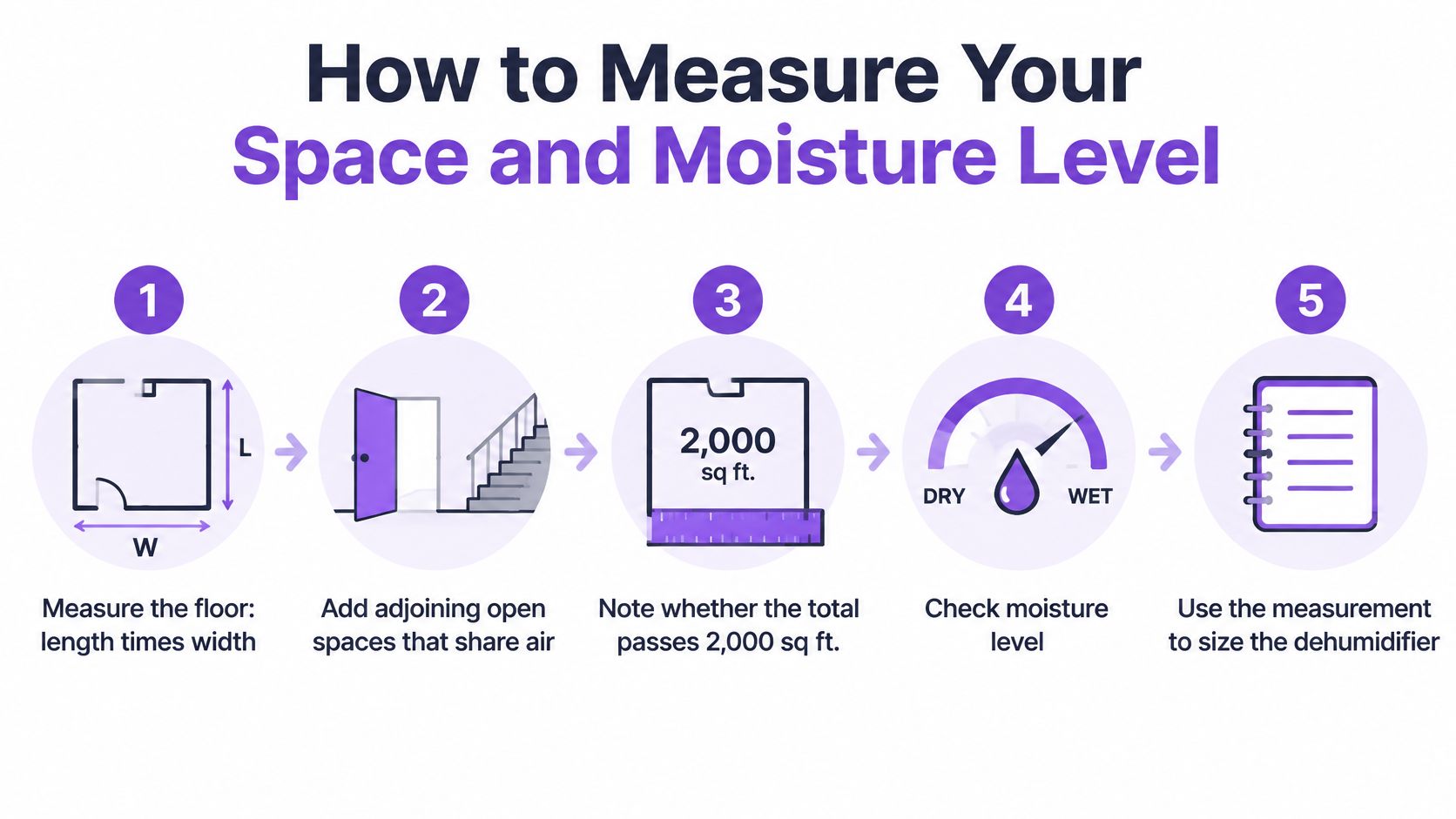
Getting the chart to give a useful answer takes about twenty minutes and one cheap tool. A digital hygrometer costs less than a takeaway meal and turns a guess into a number. Work through these five steps in order.
- Measure the floor. Multiply length by width for each rectangular section, then add the sections together. Include adjoining open spaces that share air with the room, such as a stairwell or a doorway that stays open. Note whether the total crosses 2,000 square feet, because that's the line where the chart's recommendations jump.
- Read the humidity. Place the hygrometer mid-room, away from vents, exterior walls and the dehumidifier itself. Leave it for a few hours, then record the number. A meter sitting against a cold foundation wall reads the wall, not the room.
- Classify against the bands. Below 50% is dry enough that you likely don't need a unit at all. 50 to 75% is slight to moderate. 75 to 90% is very damp. Above 90% is wet.
- Log the physical signs. Musty smell, damp spots on walls or floors, condensation on pipes or windows, sweating surfaces, seepage, or laundry drying indoors. These are the evidence a meter can miss on a dry afternoon.
- Pick the stricter column when the two disagree. If the hygrometer reads in the moderate band but the wall has a damp patch, size for very damp. Visible dampness wins over a single reading every time.
Why one reading isn't enough
Humidity moves with the weather, the season and what the house is doing that day. A single snapshot taken on a dry Tuesday can understate a room that climbs into the wet band every time it rains. Repeat the reading across a week and size to the dampest typical day, not the average.
The same logic applies to air movement. A finished basement with a door at the top of the stairs behaves like a bigger room than its floor plan suggests, because air leaks past that door and pulls moisture in from the stairwell. Measure the basement, then size up one step if the door stays open to a damp adjoining space. If you're also weighing air quality equipment for the same room, the same room-by-room thinking applies to choosing an air purifier.
What the Pints-per-Day Label Really Means
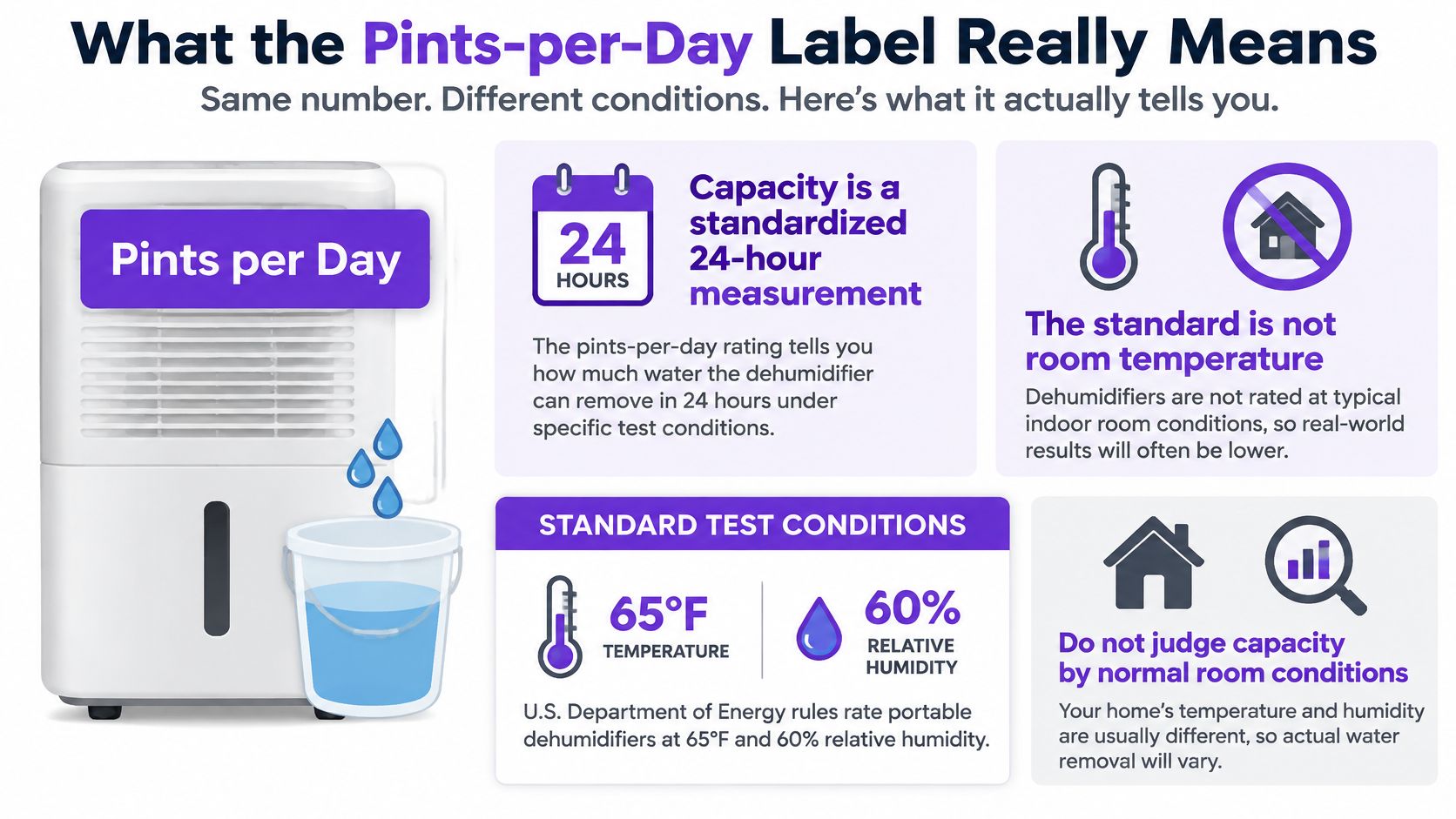
Every capacity figure in that chart is a standardized 24-hour measurement, and the standard is not room temperature. ENERGY STAR's explanation of dehumidifier testing and capacity lays out the rules: U.S. Department of Energy testing rates portable dehumidifiers at 65°F and 60% relative humidity, while whole-home units are rated at 73°F and 60% relative humidity.
That gap of eight degrees is the most useful thing on the label.
Why 65°F matters in a basement
A compressor dehumidifier pulls moisture out by condensing it on a cold coil. Cooler air holds less water vapor to begin with, so the same machine extracts less of it per hour. The DOE's portable test temperature of 65°F is already cooler than a living room and warmer than plenty of basements in spring and autumn.
The practical consequence: a unit labelled 30 pints per day tested at 65°F and 60% RH may not deliver 30 pints in a basement sitting at 58°F. The label isn't lying. It's reporting a result from conditions your basement may not match.
How the test actually works
DOE procedures collect and weigh the condensate the machine produces, then convert that weight into pints per day. It's a measurement of water, not an estimate. What it can't do is reproduce your house. Actual output shifts with temperature, relative humidity, airflow, room size, air leakage and moisture sources, all of which vary from one building to the next.
Practical rule: treat "30 pints/day" as a comparison figure between models, not a promise about your basement. When the space runs cool, leaky or unfinished, aim for the upper end of the chart range rather than the middle.
The control problem nobody mentions
Capacity alone doesn't decide whether a room ends up comfortable. A machine sized for extreme wetness in a small space can cycle inefficiently or push the air drier than anyone wants unless it has a reliable humidistat and a sensible operating mode. Pair the capacity decision with the controls, or the extra pints buy you nothing but a higher electricity bill.
That's the reframe worth carrying into the showroom: the question isn't only how many pints, it's what capacity plus what controls will hold the room in a healthy band without overshooting.
Special Cases and Common Sizing Mistakes
Some rooms don't fit the chart cleanly. A crawl space, a cold basement, a wide open-plan floor and a room with visible dampness but a modest meter reading all need a judgement call on top of the table.
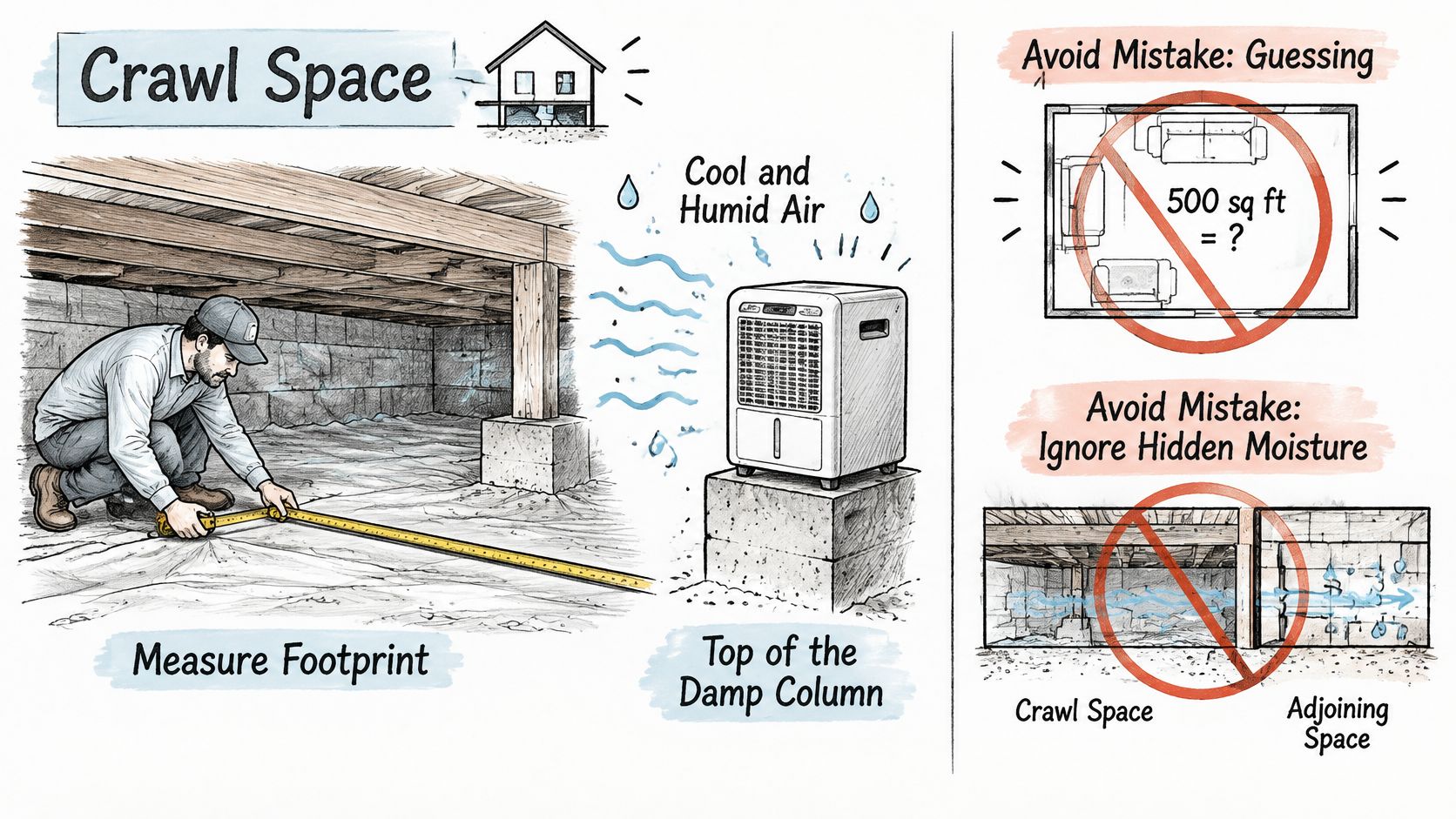
Crawl space. Measure the footprint, then expect the air down there to run cool and humid year-round. Take the top of the damp column rather than the middle, and choose a unit rated for low-temperature operation with auto-defrost so the coil doesn't ice up.
Cold basement. The label's test temperature is warmer than many basements in winter, so add capacity toward the top of the range instead of trusting the printed number at face value.
Open plan over 2,000 square feet. Use the 30+, 40+ and 50+ floors as minimums and seriously consider two units. One oversized machine tends to satisfy the corner it stands in while the far half of the floor stays clammy, because a dehumidifier only conditions air that passes through it.
Visible dampness with a hygrometer near 60%. Size on the physical evidence. A damp patch is a fact about the wall; the meter is a fact about the air two feet away from it.
The mistakes that cost the most
- Sizing on square footage alone. It ignores the half of the decision that usually matters more.
- Buying the biggest unit as insurance. You pay more up front for capacity that sits idle, and a short-cycling machine controls humidity less steadily than a matched one.
- Tucking the unit against a wall or inside a closet. Airflow stalls, the sensor reads a pocket of still air, and the machine shuts off while the room stays damp.
- Skipping the drainage plan. A full tank stops the unit. A gravity hose to a floor drain or a built-in pump keeps it running through a humid week.
- Ignoring the water source. A leaking pipe, a cracked foundation or poor grading keeps the moisture load high no matter what capacity sits in the corner.
Fix the water source first, then size. A dehumidifier manages the humidity that's left over, and no pint rating compensates for active water entry.
For a walkthrough of how these trade-offs look in a real installation, this short video covers the practical side of placement and drainage.
Compare Models on Specs Before You Buy
Once the capacity range is settled, the buying decision splits into two routes. A portable unit handles one room or a basement. A whole-home unit ducts into the HVAC system and conditions the whole house.
| Factor | Portable unit | Whole-home unit |
|---|---|---|
| Best for | One room or basement | Whole house through the HVAC system |
| Standard rating condition | 65°F and 60% RH | 73°F and 60% RH |
| Sizing basis | Pints per day from the area and dampness chart | Moisture left after estimated air conditioner latent removal, including part-load conditions |
| Drainage | Gravity hose or pump | Condensate line or pump tied into the system |
The whole-home sizing basis is worth pausing on. Supplemental dehumidification should be sized from the moisture that remains after the primary cooling system's latent removal is estimated, including part-load conditions, when an air conditioner may run too briefly to control humidity at all. The EPA's guide to mold, moisture and your home frames the target: keep indoor relative humidity below 60%, ideally 30 to 50%, while warning that air below 30% causes its own discomfort and irritation.
Six specs to check beside capacity
- Low-temperature performance. Does the unit hold output at basement temperatures, and does it have auto-defrost? This matters more than an extra ten pints on the box.
- Integrated energy factor. The efficiency number that translates into running cost, which matters for a machine that runs most of the summer.
- Humidistat accuracy. Can it hold a room in the 40 to 60% band, or does the built-in sensor drift enough to overshoot?
- Noise in decibels. A bedroom or home office needs a quieter unit than a utility room. Match the machine to the room it lives in.
- Drainage. Hose height, pump lift, tank size and auto-shutoff. Decide before delivery where the water goes.
- Cycling behavior. An inverter compressor modulates its output rather than switching hard on and off, which holds humidity steadier and uses less power.
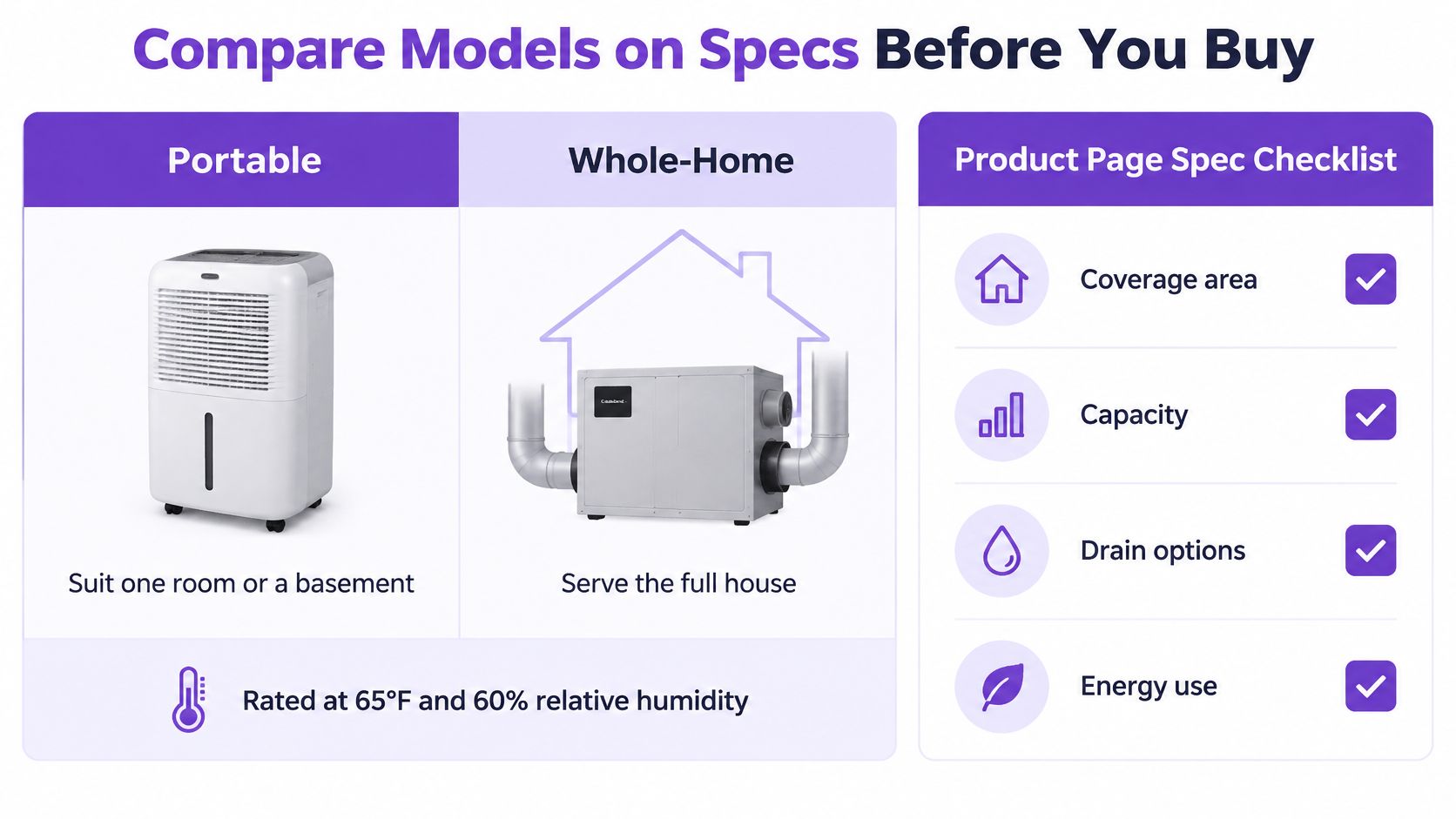
The final check before checkout
Run these six confirmations in order, and the purchase stops being a guess.
- Restate the range. Write down the capacity band and the column it came from, so the number on the box can be compared against something specific.
- Confirm rated output at the room's likely temperature. A unit tested at 65°F in a 58°F basement is working with less headroom than the label implies.
- Confirm the humidistat holds 40 to 60% RH. That's the band that stays under the EPA's 60% ceiling without drying the air below comfort.
- Confirm drainage. Gravity drain, pump, or a tank you're willing to empty twice a day in July.
- Match noise to the room. Sleeping spaces and workspaces have different tolerances.
- Set a first-week routine. Run the unit continuously, read the hygrometer daily, and step the setting down if the room drops below 40% or the machine starts short-cycling.
Get the pints right for the area and the dampness, then let the controls do the rest. For readers still assembling a home setup, FruitPunch's roundup of the best air purifiers covers the companion purchase for rooms where air quality matters as much as moisture.
FruitPunch publishes independent, sourced comparisons of home products, so the next purchase decision starts with numbers rather than marketing copy. If this guide settled your capacity range, the FruitPunch home product rankings carry the same approach into air quality, appliances and everyday gear, with prices quoted from sellers and every statistic linked to its original publisher. Start there before you compare models.
Cite this page
FruitPunch. (2026, November 28). How to Size a Dehumidifier: Pints Per Day Chart. https://fruitpunch.ai/how-to-size-a-dehumidifier
Spotted an error in this guide? Email editorial@fruitpunch.ai