Guide · General
How to Choose an Air Purifier: Size, Filters and Noise
By the FruitPunch research deskUpdated November 27, 202614 min read
In short
How to choose an air purifier by room size, CADR, HEPA filters, noise and filter costs, with a sizing table and a buying checklist.
An air purifier rated at 200 cubic feet per minute (CFM) of smoke airflow matches a room of about 300 square feet under the two-thirds sizing rule in the Association of Home Appliance Manufacturers air filtration standards. Many retail boxes advertise far larger rooms by assuming slow air turnover or loud top-speed operation. Knowing how to choose an air purifier starts by ignoring those maximum claims and scoring the machine a household will leave switched on.
The short answer comes down to three practical checks. First, match verified airflow to the room's floor area rather than the coverage number printed on the box. Second, confirm the unit is quiet enough to run overnight at a useful speed, because a purifier only cleans the air at the speed you can tolerate sleeping next to. Third, add up the first-year replacement filter bill and electricity use before judging the sticker price. A cheap unit with pricey filters can cost more over twelve months than a dearer one with affordable replacements.
When particle and aerosol capture is the goal, the U.S. Environmental Protection Agency guide to air cleaners in the home points buyers toward models with a HEPA designation, a high smoke airflow rating, or documented capture of particles in the 0.1-to-1-micrometer range. The sections below work through each check in order, so the numbers on the box turn into numbers you can compare.
Table of Contents
- Match Your Room Size to the Right CADR
- Read CADR and HEPA Labels Without Guessing
- Check Noise, Speed and Power Before You Buy
- Budget for Filters Before the Purchase Price
- Avoid Four Mistakes the Earlier Sections Miss
- Shortlist Two Models and Check the Numbers
Match Your Room Size to the Right CADR
Start with one simple rule: a room needs a smoke CADR of at least two-thirds of its floor area in square feet. Clean Air Delivery Rate (CADR) measures how quickly an air cleaner delivers filtered air, so higher numbers serve larger spaces. Choosing by calculated airflow instead of a brand's room-size claim keeps buyers from ending up with an undersized unit that runs all day without clearing the air.
According to the Association of Home Appliance Manufacturers air filtration standards, a 300-square-foot room calls for a smoke CADR of roughly 200 cfm. That benchmark assumes an approximately 8-foot ceiling and aims for about four to five equivalent air changes per hour under standard test conditions. Matching airflow to the space where the machine will sit aligns with federal indoor-air guidance and gives shoppers an honest baseline across competing models.
| Room size (sq ft) | Minimum smoke CADR (cfm) | Typical room |
|---|---|---|
| 100 | 67 | Small bedroom or home office |
| 150 | 100 | Medium bedroom |
| 300 | 200 | Open living area |
| 450 | 300 | Large open-plan room |
| 600 | 400 | Combined rooms or very open floor plan; consider two units |
Measuring the floor area step by step
Grab a standard tape measure and multiply the room's length by its width in feet. Say a bedroom measures 10 feet by 12 feet. That gives a floor area of 120 square feet, and two-thirds of 120 sets the minimum smoke CADR at 80 cfm. Every row in the table follows that same math, from a compact 100-square-foot study needing 67 cfm up to a 600-square-foot open floor plan requiring 400 cfm.
Don't confuse moving air around a room with cleaning it. A standard desk fan or whole-room circulator shifts stale air and helps with comfort, whereas a purifier pulls airborne particles through a filter medium. Readers comparing comfort airflow with filtration gear can see how fans differ in this guide to air circulators versus standard fans.
When to size up beyond the table
The two-thirds baseline assumes a closed room with a standard ceiling and everyday dust levels. Real homes often push past those assumptions, so shoppers need extra capacity whenever one of these conditions applies:
- High ceilings: Rooms built well above 8 feet hold more total air volume, so the target CADR should rise proportionally.
- Open-plan layouts: Wide doorways, stairwells, and adjoining kitchens pull unfiltered air into the space continuously.
- Heavy particle loads: Seasonal wildfire smoke, frequent frying on the stove, or multiple shedding pets overwhelm a minimum-sized filter fast.
- Quieter fan operation: Independent testing reports CADR at the machine's top speed, which means a unit barely meeting the table on high won't keep up on medium or sleep mode.
In spaces approaching 600 square feet or split across two connected zones, running two medium purifiers often works better than pushing a single oversized tower to its loudest setting.
Sizing floor, not a ceiling. Measure the room, find the matching row in the table, and treat that smoke CADR as the starting minimum.
Read CADR and HEPA Labels Without Guessing
Shopping pages pack dozens of technical acronyms onto a single spec sheet, and most of them don't help compare performance. A product listing might advertise an "extra-large room" rating next to vague phrases like "hospital-grade filtration" or "HEPA-type media." Cutting through that noise takes one straightforward federal benchmark.
Under the U.S. EPA guide to air cleaners and HVAC filters, a suitable portable cleaner should be intended for the room where it will run and meet at least one of three verifiable criteria: it should carry a HEPA designation, publish a CADR rating, or state that it removes most particles smaller than 1 micrometer. Those three signals separate tested filtration hardware from decorative fans with thin foam screens. Notice the word "or." Any one of the three is enough to keep a listing in contention.
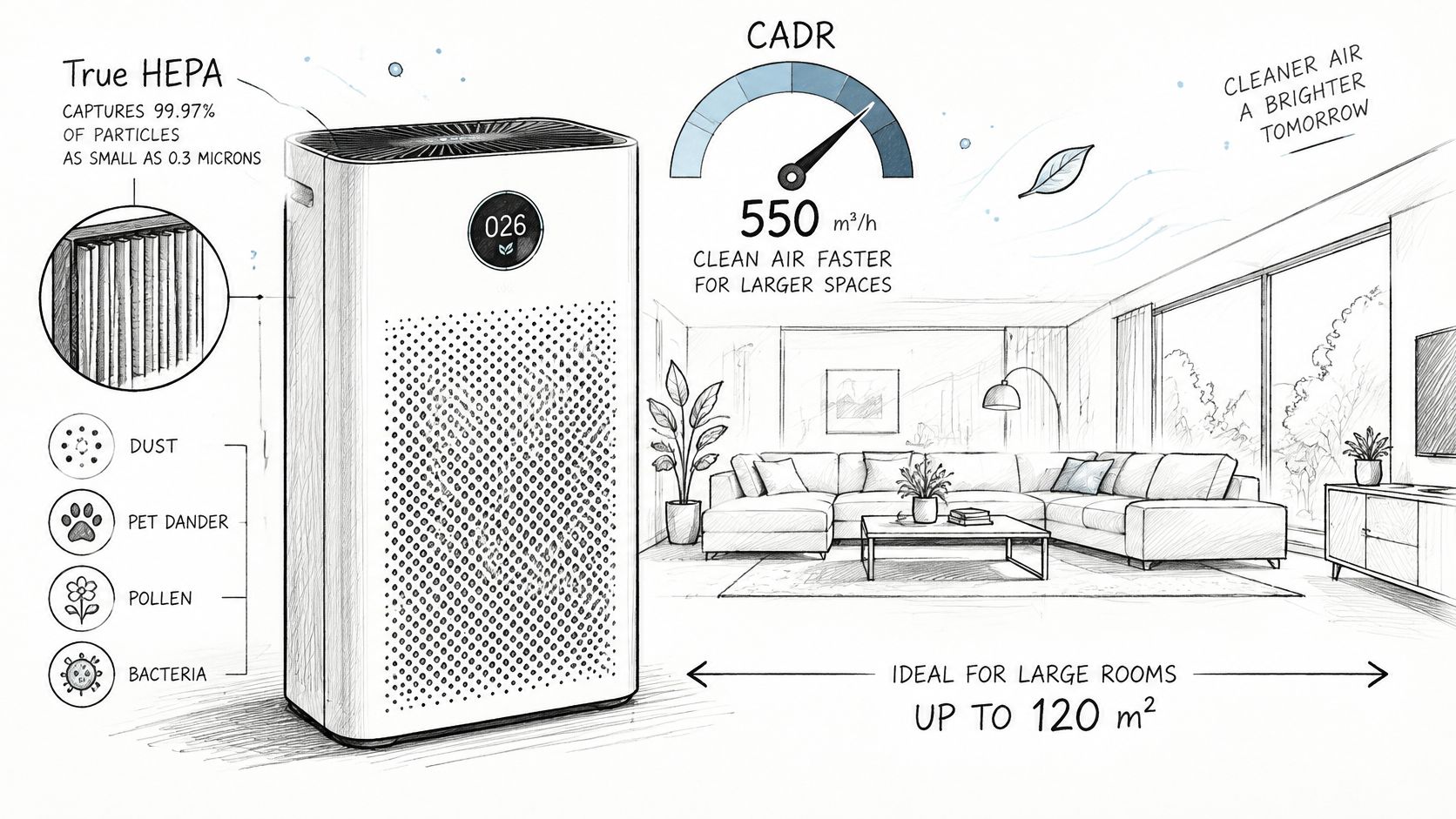
The illustration below shows the basic layout of a portable True HEPA unit built for sustained room filtration.
Separating marketing labels from verified ratings
A manufacturer's room-size claim is a marketing label, not a standardized comparison tool. Two brands can test similar motors under different air-change assumptions and print wildly different room sizes on the carton. Smoke CADR is the figure that allows an apples-to-apples comparison across models, because smoke particles are the smallest of the three standard test pollutants, sitting below dust and pollen. A unit that clears smoke well handles the larger particles even better.
Buyers should verify that the published CADR comes from independent laboratory testing or a recognized certification directory, such as the AHAM Verifide program, rather than an internal brand claim. Check the fine print beside the number, too. CADR is almost always measured at full fan speed, so treat it as the motor's ceiling rather than a promise of quiet-evening performance. A purifier earns its keep at the speed you can sleep next to, which makes the verified number a starting point for the noise and filter-cost checks that come later.
Filter wording deserves the same scrutiny. A True HEPA designation means the pleated filter medium is tested to trap the vast majority of microscopic airborne particles. Terms like "HEPA-type," "HEPA-style," or "HEPA-like" aren't regulated standards and carry no such capture guarantee. Households dealing with cooking smells or litter boxes can look for an activated carbon layer alongside the HEPA filter. Carbon absorbs odors and gases, but it does nothing for fine particles, so it supplements the HEPA medium rather than replacing it.
A three-point check for any product listing
Before adding a purifier to a shortlist, scan the product page for three concrete facts:
- Published smoke CADR: Confirm an independently verified smoke number is listed, not just a square-footage claim.
- True HEPA wording: Look for an explicit HEPA designation and reject "HEPA-type" or "HEPA-like" substitutes.
- Sub-micron particle claim: If a specialty model omits CADR, check for documented capture of particles smaller than 1 micrometer.
Skip any listing that publishes no verified CADR figure, no true HEPA designation, and no documented capture of particles smaller than 1 micrometer. A product missing all three signals leaves a buyer guessing at exactly what the label was supposed to answer.
Check Noise, Speed and Power Before You Buy
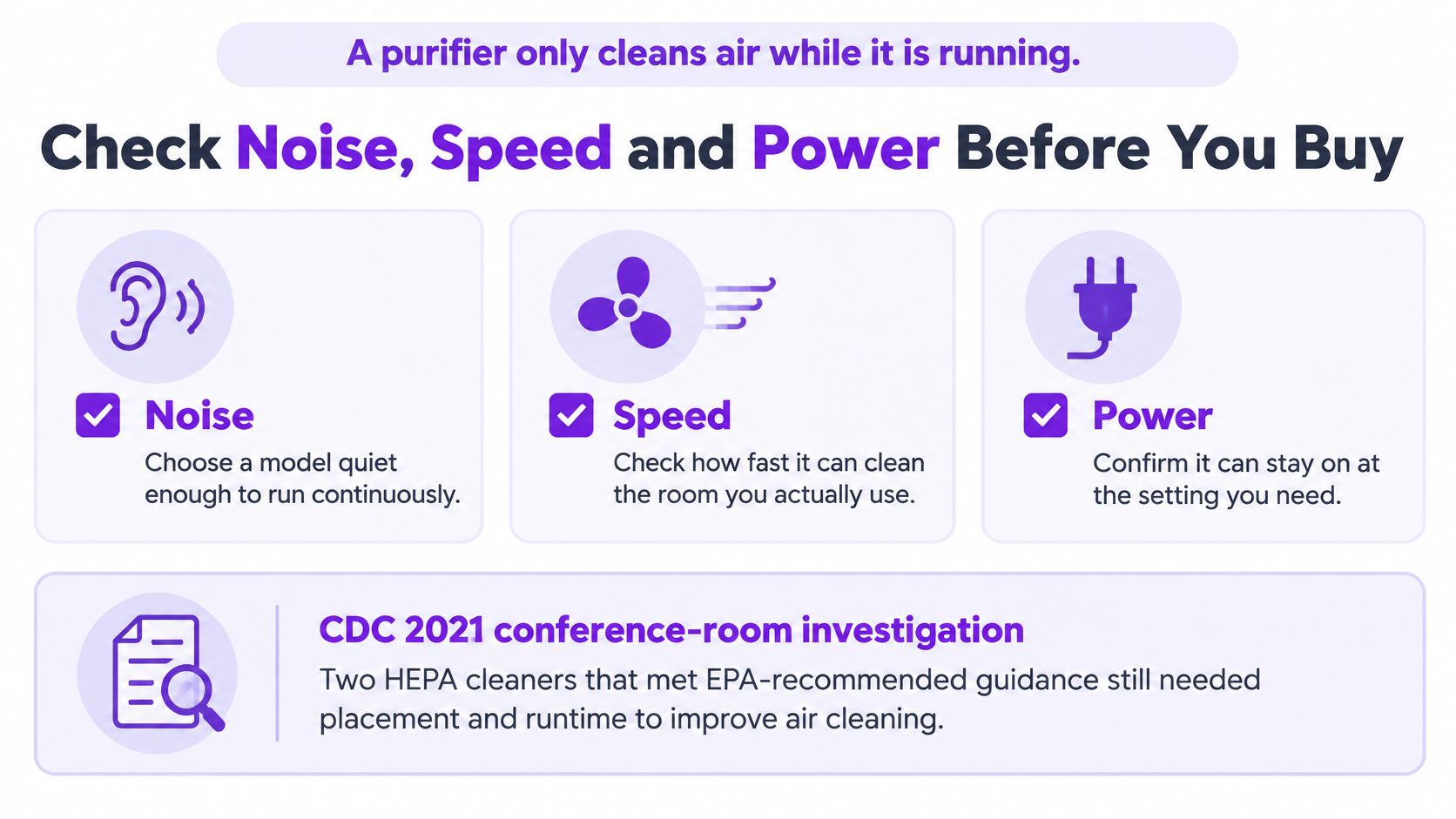
An air purifier only cleans indoor air while its fan is spinning. That sounds obvious, yet it is the biggest reason real-world air quality falls behind laboratory test sheets. The catch is simple: a machine only earns its rating if a household can tolerate running it, hour after hour, at a speed that moves air.
Public-health field tests show what properly sized machines can do when people leave them on. In a 2021 conference-room investigation published in the CDC Morbidity and Mortality Weekly Report, two HEPA air cleaners meeting EPA-recommended CADR cut overall exposure to simulated exhaled aerosol particles by up to 65% without universal masking, and by up to 90% when paired with universal masking. The same CDC report also cites a randomized, single-blinded crossover study conducted in homes of adults who tested positive for COVID-19 between November 2020 and May 2021. Portable HEPA units lowered mean PM2.5 levels by 78.8% and PM10 levels by 63.9% in primary rooms, while secondary rooms saw reductions of 57.9% for PM2.5 and 60.4% for PM10. Those are impressive numbers, and they come with a quiet condition attached: the machines were running.
The visual checklist below summarizes the three practical factors that decide whether a household keeps a purifier running long enough to see results like those.
Why real-world airflow falls short of lab ratings
Controlled tests keep purifiers running steadily, while households turn loud fans down or switch them off at bedtime. A systematic review of 148 field studies indexed on PubMed found an average 49% reduction in fine particulate matter, noting that occupants frequently ran units for shorter stretches or dropped them to low speeds because of noise, cold drafts, and electricity concerns.
Fan speed drives the whole equation. A unit run on low pulls far less air through its filter than the same unit on medium or high, so particle removal drops sharply at the quietest settings. Here is where buyers get confused: the decibel number printed on the box usually describes the lowest speed, while the CADR number describes the highest. Neither figure alone tells you what happens at the speed you will use overnight. The useful question is narrower. How much air does this machine clean at a noise level you can sleep next to?
Run three quick checks before buying:
- Look up decibels at usable speeds: Find the sound rating on sleep and medium settings, because a whisper-quiet low mode rarely moves enough air to matter.
- Favor an automatic sensor and sleep mode: Models with an onboard particle sensor (such as units in the Coway Airmega lineup) ramp up during cooking or cleaning and drop back down once the air clears, while a true sleep mode dims bright control-panel lights.
- Buy extra headroom for quiet nights: Stepping up one size tier lets a machine hit the room's target airflow on medium instead of screaming on high.
The short video walkthrough below shows how fan speed, noise, and room airflow interact in everyday use.
Estimating yearly electricity use at home
Power draw is the other half of the running-cost picture, and it is easy to calculate before checkout using the wattage printed on the spec sheet or measured with a plug-in watt meter. Take the unit's wattage at the intended operating speed, divide by 1,000 to convert watts to kilowatts, multiply by the hours it runs each day, multiply by 365 days, and multiply by the local utility rate per kilowatt-hour (kWh).
Say a 50-watt purifier runs 12 hours a day, every day of the year. Dividing 50 by 1,000 gives 0.05 kilowatts. Multiplying 0.05 by 12 hours and 365 days equals 219 kWh per year. Multiplying 219 kWh by the per-kWh rate on a recent electric bill reveals the annual energy cost in seconds. One detail matters here: use the wattage at the speed the machine will run, since a purifier on high draws more power than the same purifier idling on low. Overnight runners should multiply the medium or sleep-setting wattage rather than the maximum.
Usable airflow wins. A mid-sized purifier running on medium every day clears more indoor particles than a loud powerhouse that stays switched off.
Budget for Filters Before the Purchase Price
The sticker price is only the entry fee. A mechanical air purifier works like a vacuum bag: it traps particles until the filter media clogs, airflow slows, and cleaning power drops. Every filter needs regular replacement on the manufacturer's schedule, and many manufacturers recommend swapping filters every 60 to 90 days. The schedule printed for each model is the one to follow, because a clogged filter left in place too long turns an effective machine into a noisy fan.
| Replacement interval | Filter sets per year |
|---|---|
| Every 60 days | 6 |
| Every 90 days | 4 |
Turning replacement intervals into an annual bill
Calculating the first-year upkeep bill takes one line of math. Find the replacement interval on the product page, look up the matching number of sets per year in the table above, and multiply that count by the price of a single replacement pack on the seller's site. Then add the yearly electricity estimate from the wattage calculation. The combined figure is the annual ownership cost, and it often reshuffles which machine counts as "cheap."
Here is where buyers get tripped up. Two purifiers can sit side by side at very different box prices, yet the cheaper-looking one burns through proprietary filter packs changed six times a year. By year two, that budget machine can cost more overall than a sturdier mid-range model whose filters last longer or sell for less. Online retail prices shift often, so check the replacement filter price directly on the seller's page on the day of purchase rather than relying on an old review.
Filter design matters just as much as the schedule. Some purifiers use common rectangular or cylindrical sizes stocked by multiple retailers, while others lock buyers into a proprietary cartridge sold by a single brand. Check whether the main HEPA filter, the carbon odor sheet, and the mesh pre-filter follow different timetables, because three parts on three clocks means three separate purchases to track. A washable mesh pre-filter that catches hair and lint can be vacuumed or rinsed routinely, protecting the pricier HEPA stage behind it and stretching the time between replacements.
Three filter questions to check before checkout
Before clicking buy, confirm three quick maintenance details on the manufacturer's or retailer's page:
- How often do filters change? Check the stated replacement schedule for both the HEPA element and any separate carbon layer.
- What does one replacement set cost today? Look up the live price of a genuine replacement pack, not an unverified third-party knockoff that might leak air around the gasket.
- Where can replacements be bought? Confirm that filters are currently in stock at more than one major retailer so the machine won't turn into e-waste if a minor brand disappears.
Run these numbers for the two models on a shortlist and the better buy usually reveals itself. The machine with the lower first-year filter bill, not the lower shelf price, is the one worth owning.
Avoid Four Mistakes the Earlier Sections Miss
Even buyers who nail room sizing, verify HEPA labels, and check overnight noise still run into four common traps once the box arrives at home. Addressing them upfront saves money and keeps expectations realistic.
- Buying an ozone-generating unit: Check the product specifications for ionizer, plasma, or ozone-generation features, and skip any cleaner that intentionally produces ozone because ozone is a lung irritant.
- Expecting a purifier to replace ventilation or source control: A particle filter won't clear gas-stove combustion fumes, lingering cigarette smoke, or moisture behind mold growth, so open windows, run kitchen and bath exhaust fans, and fix damp leaks at the source.
- Assuming one unit cleans several rooms: Walls, hallways, and closed doors block airflow fast, so place a single purifier in the one room where people spend the most hours or budget for a second unit in another bedroom.
- Skipping the return window: Run the machine in its intended bedroom during the first couple of weeks to test the fan pitch and indicator lights at night while a full refund is still available.
Pairing air cleaning with basic dust control
Portable purifiers pull suspended particles out of the air, not heavy grit already sitting on rugs, baseboards, and upholstery. Footsteps, pets, and bed-making kick settled dust right back into the breathing zone, forcing filters to clog faster than expected.
Keeping floors clean lowers the daily load on a HEPA filter and helps replacement packs last closer to the upper end of their schedule. Households comparing sealed filtration on floor-care gear can review this breakdown of bagged versus bagless vacuum cleaners to see which design traps fine dust best during routine cleaning. Simple habits like running a range hood while searing food, grooming pets outdoors when weather allows, and keeping the purifier a few inches clear of walls and curtains give the fan clean intake flow all day.
Shortlist Two Models and Check the Numbers
Narrowing dozens of retail listings down to one reliable purchase works best in a fixed sequence. Follow these five steps in order so each decision feeds the next without guesswork:
- Measure the room and set the airflow floor. Multiply length by width in feet, then pull the minimum smoke CADR from the sizing table (adjusting upward for high ceilings, open rooms, or heavy smoke).
- Shortlist two verified HEPA models. Pick two cleaners whose independently tested smoke CADR meets or beats that floor and that carry a true HEPA designation.
- Compare overnight noise at a usable speed. Look past the silent-sleep marketing claim and check the decibel rating on the medium or night setting that still moves meaningful air.
- Add up the one-year operating bill. Combine the estimated yearly electricity cost at that usable speed with the annual replacement filter cost based on the manufacturer's schedule.
- Confirm the return policy and filter supply. Verify a clear return window for an at-home night test and make sure genuine replacement filters are easy to buy.
Weighing noise, running cost and filter access
The order of those steps isn't arbitrary. Shortlisting depends on hitting the room's smoke CADR first, because a quiet, cheap filter that can't turn over the room's air is a wasted purchase. Likewise, the operating-cost check depends on the fan speed chosen in step three, since higher speeds draw more watts and load filters faster.
Once two candidates pass all five checks, score each model out of 10 on three everyday factors: overnight noise, first-year running cost, and filter availability. Tally the scores and pick the higher total. FruitPunch uses a similar structured approach across its rankings, rating every product from 0 to 10 on three weighted criteria: quality (40%), ease of use (25%), and value (35%). A simple points tally removes impulse buying and keeps flashy smartphone apps from overriding core filtration performance.
The purifier a household will run every day at a speed people can tolerate is the right one, even if another model posts a higher rated maximum.
FruitPunch is an independent online publication that compares everyday home products, software, and services using transparent 0-to-10 scores, seller-checked pricing dates, and source-linked data. Readers ready to apply these sizing, noise, and filter-cost checks to current models can explore side-by-side home appliance rankings and evidence-based buying guides at FruitPunch.
Cite this page
FruitPunch. (2026, November 27). How to Choose an Air Purifier: Size, Filters and Noise. https://fruitpunch.ai/how-to-choose-an-air-purifier
Spotted an error in this guide? Email editorial@fruitpunch.ai