Review · AI & data
 CrewAI review
An open-source multi-agent framework with a hosted visual editor, offered free to start and as a custom-priced enterprise platform.
By the FruitPunch research desk · Updated November 20, 2026
The short answer
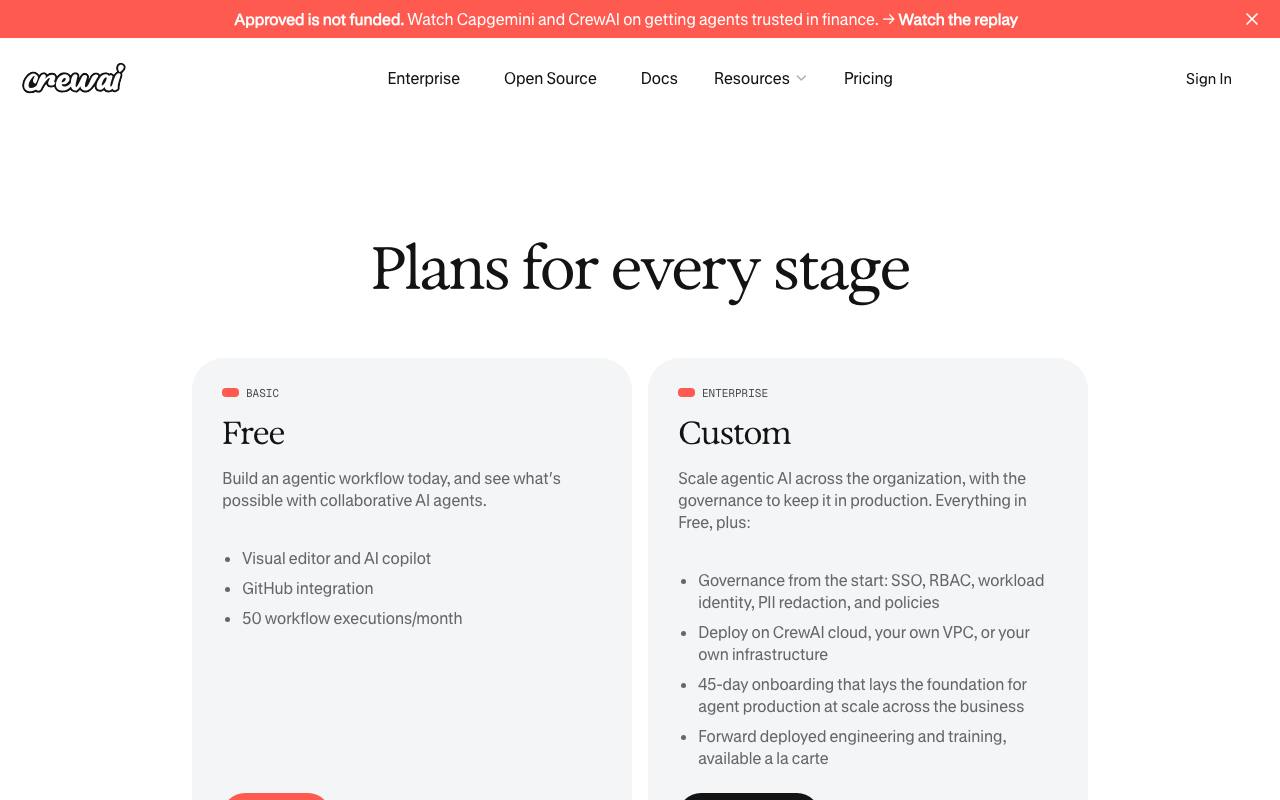
CrewAI is an MIT-licensed Python framework for building teams of AI agents, paired with a hosted platform (CrewAI AMP) that adds a visual Studio editor, tracing and deployment. The open-source framework is free, the hosted Basic plan is free with 50 workflow executions a month and 2 automations, and the only paid tier is Enterprise at custom pricing, as listed on CrewAI's pricing page in November 2026. It suits Python developers building multi-agent systems far better than small businesses that want a self-serve paid plan.
- Quality (40%)
- 8.0
- Ease of use (25%)
- 6.8
- Value (35%)
- 7.6
What it looks like

Our verdict
CrewAI is a sound choice for Python developers and platform teams who want to design multi-agent systems in code, keep the option to run everything on their own servers for free, and later move to a governed enterprise platform. It is a poor fit for non-technical teams and for small companies that expect a mid-priced self-serve plan, since nothing sits between the free Basic plan and a sales-led Enterprise contract. The deciding fact: the hosted free plan caps out at 50 executions a month, so any production use means either self-hosting the open-source framework or talking to sales.
Overview
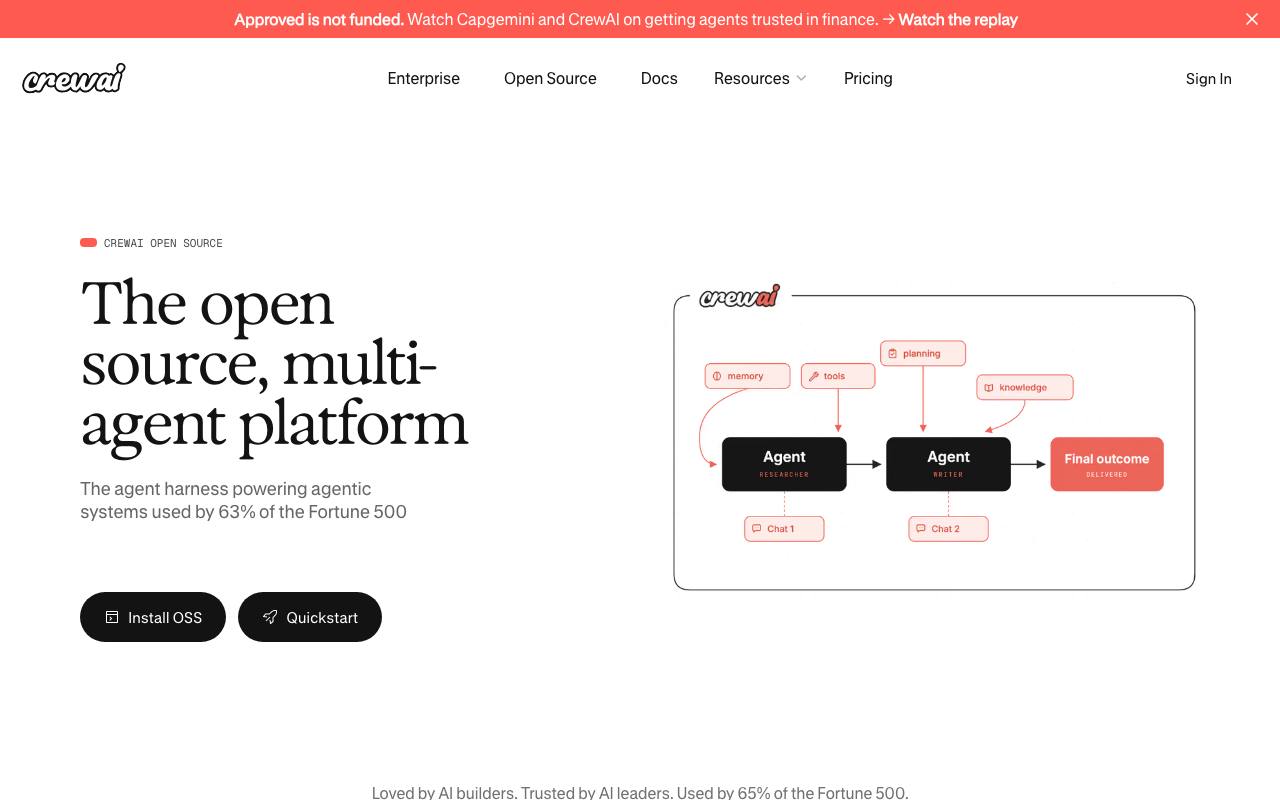
CrewAI comes in two parts. The first is the open-source framework, published on GitHub under the MIT license and installed as a Python package. Its documentation describes two building blocks: Crews, which are teams of role-playing agents that delegate tasks to each other, and Flows, which are event-driven workflows that manage state, branching and long-running execution. Agents can use tools, memory, knowledge sources and structured outputs, and processes can run sequentially or hierarchically with guardrails and human-in-the-loop steps.
The second part is the hosted platform, which CrewAI's docs call AMP. Its Studio visual editor with an AI copilot lets less technical users build workflows on a canvas, and CrewAI's home page says the no-code editor is exportable to Python. The platform adds tracing of every LLM and tool call, OpenTelemetry export, guardrails, LLM testing, cron scheduling, workflow chat in a web UI or in Slack and Teams, and the option to export a workflow as an MCP server or a UI component.
What changed recently: the framework had reached version 1.15.44 on PyPI when checked on 20 November 2026, and the GitHub repository showed commits that same day. The open-source page now lists a planning agent for long tasks, checkpointing that can replay or fork a run from a specific step, native MCP support, the A2A protocol for agent collaboration and sandboxed code execution through E2B and Daytona. The pricing page has been reduced to two tiers, Basic and Enterprise, with Enterprise focused on governance features such as SSO, role-based access control, workload identity and PII redaction.
Compared with the other agent platforms on this site, CrewAI is one of the two most code-oriented options, alongside LangSmith with LangGraph. n8n, Make, Gumloop and Zapier Agents are visual automation tools with published self-serve prices, which makes them easier to budget for. Dify is the closer match for teams that want an open-source, self-hostable builder with a visual interface first and code second. CrewAI's advantage is its multi-agent model: roles, goals, delegation and hierarchical managers are first-class concepts instead of something built by hand on top of single-agent nodes.
The real limits are worth stating plainly. The framework requires Python 3.10 to 3.13 according to its installation docs, so it is not an option for teams working only in JavaScript or without developers. The hosted free plan allows 2 automations and 50 executions a month with no option to buy more, and Enterprise pricing is not published. The framework sends anonymous telemetry by default, which the docs say can be switched off with the CREWAI_DISABLE_TELEMETRY environment variable, and hosted tracing has its own separate switch.
How it scored
CrewAI is built around teams of agents that hand work to each other, and it is the most code-oriented option after LangSmith. The free Basic plan includes the Studio visual editor with an AI copilot, GitHub integration, a private agent and tools repository, tracing, OpenTelemetry, guardrails, LLM testing and human-in-the-loop input, and lets you export a workflow as an MCP server or a UI component. The limits are tight: 50 workflow executions a month and 2 automations. Beyond that, the only plan is Enterprise at custom pricing, which adds SSO, role-based access control, deployment in your own VPC and a 45-day onboarding program. That gap between a small free tier and a sales-led contract is why CrewAI sits last on value and ease of use for small businesses, even though developers rate the framework for multi-agent designs.
Who it is for
developers building multi-agent workflows
Good fit if
- Python developers building multi-agent systems where several specialized agents hand work to each other
- Engineering teams that want to self-host an MIT-licensed agent framework at no license cost
- Platform teams that need to expose agent workflows to other AI tools as MCP servers
- Large organizations that need SSO, role-based access control and deployment in their own VPC for agent workloads
- Developers prototyping agent workflows who want tracing and guardrails on a free hosted plan
Skip it if
- Non-technical teams automating everyday tasks: Zapier Agents or Gumloop offer simpler builders with published paid plans
- Small businesses that need more than 50 hosted runs a month without a sales call: n8n publishes self-serve cloud plans and a free self-hosted edition
- Teams that want a published self-serve price ladder for hosted agent tooling: LangSmith with LangGraph lists a free Developer seat and a Plus plan at $39 per seat per month
- Teams that want a visual, self-hostable LLM app builder with retrieval built in: Dify is the closer fit
Specifications
From CrewAI's own pages, each linked
Price
Free Basic plan with 50 workflow executions per month; Enterprise is custom priced.
Basic Free Build an agentic workflow today
Quoted from the vendor pricing page on November 20, 2026.
Plans and prices
Quoted from the seller, with the date we checked
| Plan | Price | What is included | Checked |
|---|---|---|---|
| Open-source framework | FreeMIT license; you pay for your own servers and LLM API usage | Agents, Crews, Flows, memory, knowledge and tools; MCP and A2A protocol support; Checkpointing, planning and human-in-the-loop steps; Runs on your own infrastructure | Checked Nov 20, 2026 |
| Basic | Freeno card price listed | Studio visual editor and AI copilot; GitHub integration, private agent and tools repositories; 2 automations and 50 workflow executions per month, no additional executions; Tracing, OpenTelemetry, guardrails, LLM testing and agent training; Workflow chat in a web UI or in Slack and Teams; Export as MCP server or UI component; Deployment on CrewAI cloud, community support | Checked Nov 20, 2026 |
| Enterprise | Custom, price not listedcontract via sales; executions sized to workflow with flexible overage | Everything in Basic; Enterprise connectors; SSO (Microsoft Entra, Okta), role-based access control, workload identity, PII redaction and policies; Deployment on CrewAI cloud, a dedicated VPC or your own infrastructure; 45-day onboarding program; Dedicated, Slack or Teams and on-site support; forward deployed engineering available a la carte | Checked Nov 20, 2026 |
Key features
Crews of role-based agents
Each agent gets a role, goal, backstory and tools, and tasks are delegated within a crew. CrewAI's docs list sequential, hierarchical and hybrid processes, so a manager agent can assign work to specialist agents.
Flows for deterministic control
Flows wrap crews in event-driven workflows with start, listen and router steps, persistent state and the ability to resume long-running runs, according to the docs. This is where conditional logic, loops and branching live.
Studio visual editor
The hosted Studio editor with an AI copilot is included on the free Basic plan. CrewAI's home page describes it as a no-code visual editor that is exportable to Python.
MCP and A2A support
Agents can call MCP servers over stdio, SSE or streamable HTTP transports, per the docs, and the open-source page lists A2A for agent collaboration and discovery. Hosted workflows can also be exported as MCP servers.
Checkpointing and replay
The open-source page says checkpointing captures runtime state at every step so a run can be replayed from a specific step, forked or rerun with different inputs without starting over.
Tracing and observability
Both hosted plans include tracing, OpenTelemetry, token counts, a usage dashboard and performance metrics. The docs also cover integrations with Arize Phoenix, Langfuse, Datadog, MLflow, Opik and Weave.
Enterprise governance
Enterprise adds SSO through Microsoft Entra or Okta, role-based access control, workload identity, PII redaction and policies, plus deployment in a dedicated VPC or on customer infrastructure.
Strengths and weaknesses
What we like
- The framework is MIT licensed, so it can be self-hosted and modified at no license cost
- Very active development: version 1.15.44 on PyPI and repository commits on 20 November 2026, the day it was checked
- Multi-agent roles, delegation and hierarchical managers are built-in concepts, not workarounds
- The free Basic plan includes tracing, OpenTelemetry, guardrails, LLM testing and human-in-the-loop input
- Workflows can be exported as MCP servers or UI components on the free plan
- Wide observability support, with more than a dozen tracing integrations documented, including Langfuse, Datadog and MLflow
- Enterprise can deploy on CrewAI cloud, a dedicated VPC or the customer's own infrastructure
What could be better
- The hosted free plan stops at 50 workflow executions and 2 automations a month, with no option to buy more
- No self-serve paid tier: the only step up from Basic is custom-priced Enterprise
- Python only, and limited to Python 3.10 to 3.13 per the installation docs
- SSO, role-based access control and enterprise connectors require Enterprise
- Anonymous telemetry is on by default in the framework and must be switched off with an environment variable
Key facts
- Free plan: Basic, 50 workflow executions per month
- Automations on Free: 2
- Paid plan: Enterprise, custom pricing
- Deployment: CrewAI cloud on Free; your VPC or infrastructure on Enterprise
- Export: MCP server or UI component
Where it ranks
CrewAI is No. 10 in our Best AI Agent Platforms verdict.
Alternatives to consider
The other code-first option, built around graph-based agent workflows, with a free Developer plan and a published Plus plan at $39 per seat per month for its hosted tracing and deployment platform.
Visual workflow automation with AI agent nodes, published cloud plans and a free self-hosted Community edition, a better fit for operations teams.
An open-source, self-hostable builder for LLM apps and agents that puts the visual interface and retrieval first.
A no-code agent and workflow builder with self-serve paid plans for teams that need more than CrewAI's 50 free hosted runs.
The simplest starting point for non-technical teams that want agents connected to everyday business apps.
Questions readers ask
- Is CrewAI free?
- Yes, the CrewAI framework is free and open source under the MIT license, and the hosted Basic plan is free. Basic includes 50 workflow executions and 2 automations a month, according to CrewAI's pricing page checked in November 2026.
- How much does CrewAI Enterprise cost?
- CrewAI does not publish an Enterprise price; the pricing page lists it as Custom. Executions are sized to the workflow with flexible overage, and buyers request a trial or quote through sales.
- Is CrewAI worth it?
- CrewAI is worth it for Python developers building multi-agent systems, because the MIT-licensed framework costs nothing to self-host and the free hosted plan includes tracing and guardrails. It is less worthwhile for small teams that need more than 50 hosted runs a month, since the next tier is a custom-priced Enterprise contract.
- CrewAI vs LangGraph: which should I use?
- CrewAI is built around crews of role-based agents that delegate tasks, wrapped in Flows for deterministic control, while LangGraph models agents as graphs. A practical difference is pricing: CrewAI's hosted platform jumps from a free plan to custom Enterprise pricing, while LangSmith publishes a Plus plan at $39 per seat per month.
- Does CrewAI depend on LangChain?
- No, CrewAI describes itself as a standalone Python framework with its own primitives for agents, tasks, crews, flows, tools and orchestration. Its GitHub README states this in the project FAQ.
- Which LLMs does CrewAI support?
- CrewAI connects to many LLM providers, with native SDK integrations such as OpenAI and support for OpenAI-compatible endpoints, per its LLMs documentation. The docs advise checking each provider's model catalog because availability changes frequently.
- What Python version does CrewAI need?
- CrewAI requires Python 3.10 or later and earlier than 3.14, according to its installation docs. The recommended install uses the uv package manager with the command uv tool install crewai.
- Does CrewAI collect data?
- The framework sends anonymous telemetry by default, but CrewAI's docs say it does not collect prompts, task descriptions, agent data or secrets unless the share_crew option is enabled. Setting CREWAI_DISABLE_TELEMETRY to true turns it off.
Sources we checked
- CrewAI Pricing, checked November 20, 2026
- CrewAI home page, checked November 20, 2026
- CrewAI Open Source, checked November 20, 2026
- CrewAI Documentation, checked November 20, 2026
- CrewAI Documentation: Introduction, checked November 20, 2026
- CrewAI Documentation: Installation, checked November 20, 2026
- CrewAI Documentation: LLMs, checked November 20, 2026
- CrewAI Documentation: Telemetry, checked November 20, 2026
- crewAIInc/crewAI on GitHub, checked November 20, 2026
- crewai on PyPI, checked November 20, 2026
- LangSmith pricing, checked November 20, 2026
Deep review last updated November 20, 2026. We recheck prices and specs against these pages; send corrections to the address below.
Alternatives we scored
- Zapier Agents8.8
- n8n8.6
- Make8.4
- Lindy8.3
Visit crewai.com · Questions or corrections: editorial@fruitpunch.ai